
The HR and Work Tech market has always had winners and losers. What’s different now is the speed and the direction.
Every category in this market is being reshaped simultaneously. Not gradually. Not in sequence. All at once. And the forces doing the reshaping: agentic AI, platform consolidation, and a buyer base that is finally being forced to choose, are moving faster than any previous technology cycle this market has seen.
The old frameworks still matter. Total addressable market. Competitive moat. Category leadership. But they are no longer sufficient. Because none of them account for timing. And timing, right now, is everything.
The windows are moving. This series maps where they are, how fast they’re moving, and what that means if you’re a CHRO making technology decisions, an investor gauging where capital should go, or a strategic platform deciding what to build, buy, or leave behind.
Introducing the Series
Eight years. 2,400+ transactions. 65+ categories across the HR and Work Tech ecosystem.
That is the foundation of this series, a proprietary WorkTech funding dataset built transaction by transaction since 2017, layered with buyer adoption research, AI adoption data, and the analyst lens that comes from three decades as an HR leader, tech executive, and B2B founder.
The series is called Opening & Closing Market Windows. It runs through October 2026, publishing weekly, more than 20 reports covering more than 65 WorkTech categories, with a State of the Market report dropping on October 13, one week before the HR Technology Conference in Las Vegas.
Every piece covers the same five dimensions across all categories: funding data, buyer trends, adoption data, M&A activity, and WorkTech’s unique lens applied to it all. Every piece produces the same output, delivering a clear window status: Closing Fast, Open But Closing, or Open & Building, with evidence to back it up.
This is not a list of hot categories. It is not a vendor landscape. It is a market timing map. And the timing, right now, has never mattered more.
The Model
To read the windows correctly, you need three things: a market structure, four variables, and a way to score each category against both.
The Market Structure: The Hourglass
The HR and Work Tech market is not a flat competitive landscape. It is an hourglass, and understanding its shape is the foundation of everything that follows in this series.
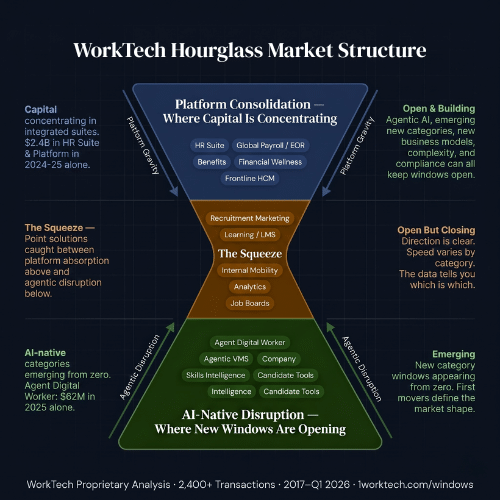
The wide top is where platform consolidation is pulling capital. HR Suite and platform plays, global payroll and EOR infrastructure, benefits administration, financial wellness, and other emerging categories are the areas where the biggest rounds are going and where the gravitational force is strongest. $2.4 billion flowed into HR Suite and Platform plays in 2024-25 alone. Near peak levels. The platforms are not slowing down.
The narrow middle is the squeeze. Point solutions that built real businesses over the past decade are now caught between two forces: platforms absorbing their use cases from above, and AI-native entrants disrupting their core value proposition from below. Recruitment Marketing. Internal Mobility. Standalone Employee Engagement. Generic Talent Management Suites. The funding data is unambiguous about what is happening here.
The wide bottom is where new windows are opening. Agent Digital Workers. Agentic VMS. Skills Intelligence infrastructure. Candidate Tools. These categories did not exist in the funding data three years ago. They are appearing from zero, which is the clearest signal in the dataset that something structural is shifting.
The Four Variables
Window status is not a static label. It is a function of three variables moving simultaneously, with a fourth factor that can extend or compress the timeline for any of them.

The first is the pace of AI and agentic innovation. How fast is AI coming at this category? Is it layering over existing systems, replacing core workflows, or creating entirely new capabilities that make the old model obsolete? The pace varies dramatically by category, and it is accelerating across the board.
The second is the pace of customer adoption. Sapient Insights data shows that 80% of HR professionals now use AI tools personally for work tasks. But only 31% of organizations have embedded AI institutionally. That gap, between personal experimentation and organizational deployment, is where windows are most vulnerable. Categories where buyers are experimenting but not committing are in a dangerous middle state.
The third is the time horizon. Some windows are closing in months. Some have years of runway. Some closed before most people noticed. The combination of the pace of innovation and the pace of adoption determines how much time remains and whether there is enough runway for a point solution to reinvent itself before the window closes.
The fourth factor is complexity, and it is the one most often underestimated in conversations about AI disruption. Regional and global compliance requirements, jurisdictional variation, and the organizational context required to apply AI correctly are not problems that automation solves on its own. They require expertise, judgment, and human oversight that technology enables but cannot replace. In categories where compliance complexity is high, contingent workforce management, global payroll, benefits administration, and certain talent acquisition workflows, to name a few, the window stays open longer precisely because the stakes of getting it wrong are too high to automate without accountability. This is not a reason to ignore the window. It is a reason to understand what kind of solution the window requires.
The Window Scorecard
Every article in this series scores its category across five dimensions using the same framework. You will see this scorecard in every piece — here is what each dimension means.

Funding Data: Is capital flowing in, holding, or drying up? What does the trajectory look like over eight years, and what does the most recent 18 months tell us about where it is going?
Buyer Trends: What are buyers actually doing? Purchasing, replacing, consolidating, deferring, or abandoning? This is where stated priorities meet revealed behavior.
Adoption Data: Where are customers on the curve? Experimenting, scaling, plateauing, or walking away? The gap between adoption and institutional deployment is often where the real story lives.
M&A Activity: What are the acquisition signals, consolidation patterns, and exit activity telling us? Who is buying what, and what does that reveal about which windows are open long enough to matter?
WorkTech Lens: The synthesis. What does the combination of all four signals mean for this category’s window status? This is where the data becomes a decision.
The Data Foundation
Before we look at individual categories, it helps to see the full picture.
The chart below shows total WorkTech funding by year from 2017 through Q1 2026. 2,400+ transactions across 65+ categories. Look at the shape of it. The market grew steadily from 2017 through 2020, then exploded in 2021. The peak was not a trend. It was an anomaly, a combination of zero interest rates, pandemic-driven digital acceleration, and speculative capital that flooded every technology sector simultaneously.
Then it stopped.
2022 was the beginning of the contraction. 2023 was the bottom. And 2024-25 is where things get interesting because the recovery is not broad. It is selective. Capital is not returning to the categories that peaked in 2021. It is concentrating in a much smaller set of categories that are winning the platform consolidation race or opening genuinely new windows through AI-native disruption.
That selectivity is the signal. And it is the foundation of every window assessment in this series.
WorkTech Global Funding 2017–Q1 2026. Source: WorkTech Proprietary Data, 2,400+ transactions across 65+ categories.
The Window Taxonomy
Every category in this series gets one of three window status labels. Here is what each one means.
Closing Fast means the funding has dried up, buyer behavior has shifted, and platform absorption is either underway or already complete. VC has voted. The window is not closing, it is closed, or close enough that the distinction no longer matters for most decisions. Recruitment Marketing. Internal Mobility. Traditional Job Boards. Standalone Employee Engagement. These are the categories where the evidence is unambiguous.
Open But Closing means capital is still flowing, deals are still happening, but the momentum is narrowing. The reinvention thesis is visible in the data: the vendors funded in these categories are not doing what the categories were built to do. They are doing something adjacent, something AI-native, something that the platform has not yet absorbed. The window is open. The question is whether there is enough time and enough differentiation to build a defensible position before it closes.
Open & Building means new funding is appearing, new deal types are emerging, and early signals of category-defining vendors are forming. These are the categories where agentic AI is creating genuinely new market space, not disrupting existing vendors, but building something that did not exist before. The window is wide open. The risk is not that it closes too fast. The risk is that you mistake an early signal for a mature market and price yourself out of a category that is still being defined.
The window status labels are not permanent. They are a snapshot of direction and speed at this moment in time. A category that is Open But Closing today could be Closing Fast by the time the final report drops in October. That is the point of running this series in real time: the windows are moving, and so is the analysis.
The Full Map
Each category below will be covered in a dedicated WorkTech report — with funding data, buyer trends, adoption signals, M&A activity, and analysis of select providers. Follow the series at 1worktech.com/windows →
A note on market segments and regions
Window status is not uniform across company size, industry vertical, or geography. A category that is Closing Fast for a large enterprise may still have a viable window for a mid-market or SMB player, where platform absorption has not yet reached its peak. A category that is Open & Building in North America may be at a different stage in EMEA, APAC, or emerging markets, where the infrastructure layer is still being built. And in regulated industries, healthcare, financial services, government, complexity and compliance requirements extend windows that would otherwise be closing.
Every category assessment in this series notes where market segment and regional variation change the window status. The default assessment reflects the broadest signal in the data. The nuances are where the real decisions live.
The Closing Fast Categories
These are the categories where the market has already voted and where the lag between capital withdrawal and operator acceptance has been the most expensive mistake in the market.
Recruitment Marketing
Funding peaked in 2021 and went down to a trickle in 2024-25. The platform-embedding play has already happened; service providers and agencies are delivering tech wrapped in expertise, and agents are on the march.
Internal Mobility
Zero deals and zero dollars in 2024-25. AI-native talent intelligence at the platform layer absorbed this use case entirely.
Standalone Employee Engagement, Feedback, Mentoring, and Onboarding
All at or near zero in 2024-25 funding. These are platform features now, not investable categories.
Generic Talent Management Suite, Performance Management, and Compensation
Down 85-95% from peak. The only investments happening here are in vendors that have already transformed into something else.
Traditional Job Boards
True marketplaces with value-adds like AI matching, candidate coaching, embedded financial services, and vertical specialization have a future. The pure transactional job ad model days are numbered.
The Open But Closing Categories
These categories are still being funded, but trend data show that the funded plays are doing something fundamentally different from what the categories were built to do. The window is open. The question is whether there is enough time and differentiation to build before it closes.
Talent Marketplaces
True marketplaces adding value on both sides: workforce management, pay, AI matching, candidate coaching, career pathing, embedded financial services, and vertical specialization are still attracting capital. Regional note: emerging-market marketplaces with embedded financial services (EOR, payments, benefits) are an accelerating trend, particularly in APAC, Africa, and Latin America.
Learning and LMS
The generic enterprise LMS window is closing. What’s getting funded and bought by the enterprise is AI-native delivery, frontline-specific, and skills-based pathways.
Analytics
Standalone people analytics without domain expertise or a platform to ride is among the most vulnerable categories to agentic disruption. AI layering directly over systems of record removes the need for a separate analytics pipeline. The window belongs to specialized expertise, plays, and platform-embedded intelligence, not generic dashboard vendors.
ATS and TA Suite
Still $216M in 2024-25, but the category is splitting. Established ATS players with large customer bases have a window to make the shift: AI-native interfaces, voice, agentic workflows, and expanded offerings that deepen the platform moat. Those that don’t make that shift will cede ground to AI-native startups building without legacy constraints. Two very different futures inside one category name.
Assessment and Pre-Hire Technology
Traditional psychometric assessment is being commoditized by AI screening. The open window is skills simulation, AI-native credential verification, and background intelligence.
Employee Experience and Engagement
The standalone engagement survey tool window is closed. The outcome-connected, manager-enablement EX platform that ties experience data to business performance is the open window inside a closing category.
Workforce Management and Scheduling
Generic enterprise WFM is consolidating into HCM platforms. Frontline-specific and vertical WFM in markets like healthcare, construction, and retail is open and accelerating.
Onboarding
Always adjacent, never its own category. Agentic AI and frontline complexity may finally be creating conditions for a defensible standalone position, but the jury is still out.
The Open & Building Categories
These are the categories where new capital is appearing, new deal types are emerging, and the first signals of category-defining vendors are forming.
HR Suite and Platform
$2.4B in 2024-25 — near peak levels. The dominant investment theme in the entire market. Core HR, payroll, benefits, EOR, and AI in a single integrated platform. This is the wide top of the hourglass.
Financial Wellness and Earned Wage Access
Peak funding year in 2026 — right now. Payroll is becoming a financial services distribution channel, and EWA is the wedge. The largest single geographic opportunity is emerging markets, where mobile payroll is the primary financial infrastructure.
Benefits Administration
ICHRA, AI benefits brokers, elective benefits, global benefits for EOR-expanded workforces. Regulatory complexity keeps this window open even as platforms try to absorb it.
Agentic VMS and Contingent Workforce Management
The most clearly defined uninvested thesis in Work Tech right now. Traditional VMS funding cratered. The first agentic entrant to standardize compliance, contracts, and processes across any company size wins a massive market while displacing incumbents.
Agent Digital Worker and Agent Companion
Appeared from zero in 2025. $62M in Agent Digital Worker funding in 2025 alone. The category that will eat Workflow Automation, parts of Recruitment Marketing, parts of Analytics, and the traditional VMS model.
Skills Intelligence
Brand new subcategory seeing $51M in 2024-25, zero before. The infrastructure layer for the skills-based organization. The open window is for the vendor that standardizes the skills data layer across platforms.
Frontline Technology
The single most important cross-category theme in the 2024-25 data. Shows up in WFM, Learning, Payroll, Safety, Collaboration, and new HR Suite plays simultaneously. Two decades of enterprise HR tech left 80% of the global workforce underserved.
Staffing, RPO, and Services-Led Technology
One of the most consistently funded investment theses in the dataset — and one of the least discussed. Services provide the distribution, trust, and outcome accountability that pure-play SaaS cannot easily replicate.
What This Means for You
This series exists because the timing question has never been harder or more consequential.
CHROs are being asked to modernize their stacks while their vendors are being absorbed, their budgets are compressed, and the definition of what “good” looks like is being rewritten by AI in real time. The CHRO who buys a point solution in a Closing Fast category today is not making a bad technology decision — they are making a bad timing decision. Those are different problems, and only one of them shows up in a vendor demo.
Investors are being asked to underwrite categories where window status determines the return profile more than product quality does. A well-built product in a closed window is a stranded asset. An early-stage product in a wide-open window is a different kind of bet entirely. The funding data shows which is which — if you know how to read it.
M&A teams are timing acquisitions in a market where a 12-month difference between buying and waiting can mean the difference between a strategic asset and a liability. The Platform Gravity Belt is pulling capital toward consolidation plays right now. The acquisition window for Core HR assets as platform bolt-ons is open, and price compression is happening in real time. Waiting is a decision.
And for the vendors and founders building in this market: the window you are in matters more than the product you are building. Not because the product does not matter, it does. But because the best product in a closing window is still in a closing window. The series will tell you where the windows are. What you do with that information is yours.
The data is here. The framework is here. The analysis starts now.
Twenty pieces. Nineteen categories. One State of the Market report dropping on October 13, one week before the HR Technology Conference in Las Vegas.
The windows are moving. Let’s map them together.
— George LaRocque, WorkTech
Next: Article 2 — The Market Has Already Voted: The Categories Where the Window Is Closed. Publishing May 29.

