
There is a particular kind of expensive mistake that happens in markets moving this fast.
It is not the mistake of investing in the wrong technology. It is the mistake of investing in the right technology at the wrong time, after the window has already closed.
The lag between when capital stops flowing into a category and when buyers, operators, and founders accept that signal is where the money gets lost. VC moves first. The market follows. And in the gap between those two moments, decisions get made that will take years to unwind.
The categories in this report are not declining. They are not struggling. They are absorbed, turned into features on a platform roadmap, consolidated into the stack, or displaced by a capability that does the same job at a fraction of the cost. The window did not close gradually. It closed, and most of the market has not fully accepted it yet.
That gap is what this report is about.
What Closing Fast Actually Means
Closing Fast doesn’t mean a category is dead. It means the window for independent investment as a standalone vendor, as a point-solution purchase, or as a venture-backed growth story has closed or is close enough to closed that the distinction no longer matters for most decisions.
The signal is not one data point. It is the convergence of four:
Funding
Dried up. Not slowed. Dried up. The deals still happening in these categories are not platform investments. They are micro-plays, tactical repositions, or AI wrappers on a dying model. When VC stops writing the small checks too, the verdict is in.
Buyer Behavior
The CHRO who was evaluating a standalone vendor in this category two years ago is no longer evaluating at the enterprise level. The budget conversation has moved, either to the platform that absorbed the use case, or to higher-priority categories with a clearer ROI story right now. What remains in the closing window categories is a pattern of calculated deferral: buyers deprioritizing the category at scale, running pilots with early-stage providers to fill a temporary gap, and signing smaller deals with niche vendors to solve an isolated need in one division or location, often at a steep discount, while they buy time waiting for the platform to catch up or for AI to clarify the best path forward for the enterprise. It looks like activity. It is not investment. It is a holding pattern, and one of the clearest signs that a window is closing rather than building.
M&A Activity
Both the volume and the nature of deals matter. A flurry of small acqui-hires signals something different than a strategic platform acquisition, and the absence of signals does not mean the window is open. It may be the calm before the noise, the moment just before platform players move and close the window permanently. The more important question is how far the market has already moved beyond a category, or is on pace to move. For example, a category like voice AI may show growing deal signals today, but if the major platform players have already acquired or built that capability, the window for an independent vendor is closing regardless of how much activity the data shows. M&A signals in closing-window categories often arrive after the strategic decision has been made, meaning that by the time the deals become visible, the window has already closed.
Platform Absorption
The use case did not disappear. The buyer still needs the capability. But they are getting it, or expecting to get it, from a platform they already pay for. The standalone vendor is no longer competing with other standalone vendors. They are competing with a line item on a renewal. That is a different competitive dynamic entirely, and it’s one that most point solutions are not built to win.
When all four of these converge on the same category, the window is closed. The categories in this report hit all four.
These are the stories of those squeezed in the middle.

The Categories
Eight years of funding data do not lie. The categories below have been assessed across all four signals: funding trajectory, buyer behavior, M&A activity, and platform absorption. The verdict on each is the same: the window is closed, or close enough that the distinction no longer matters.
Closed does not mean gone. The use cases are real. The buyers still have the need. What is gone is the independent investment thesis, the standalone vendor, the point-solution purchase, or the venture-backed growth story. In every category below, that thesis has been absorbed, displaced, or rendered obsolete. What remains are features, line items, and holdover contracts that are running out their terms.
The funding data tells the story clearly. Peak year (2021 for all) versus 2024-25, across every category in this report.
*Employee Engagement and Generic TM/PM/Comp 2024-25 figures reflect AI-native repositioning plays, not standalone point solutions.
** Traditional Job Boards 2024-25 figure reflects evolved marketplace model, not pure transactional job ad model.
Closed windows for the squeezed middle do not mean closed windows across the entire category. The use case doesn’t disappear; it transforms. In every category below, there are vendors who have already made that transformation, platform players who have absorbed and extended a capability, and service providers who have built technology that entirely transcends the original category definition. The difference between a closed window and an open one in the same category is not the use case. It is the business model, the buyer, and the layer of the stack.
In the category-specific reports that follow in this series, we will name names: the vendors navigating these windows well, the platforms making the moves, and the point solutions running out of time.
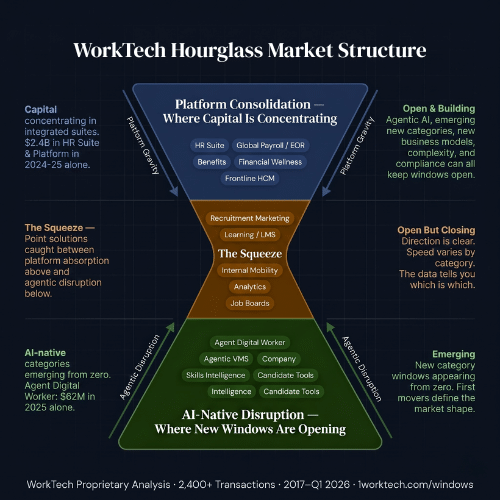
The categories below sit in the narrow middle, caught between platform absorption from above and agentic disruption from below.
Recruitment Marketing
Peak funding in 2021. Down to $4M in 2024-25 across five deals, and the trend data on those deals says it all: employee referrals, employee-generated video, AI wrappers. These are not platform investments. They are tactical micro-plays by vendors trying to find a foothold in a category that has already been absorbed. The standalone Recruitment Marketing vendor is not losing to other standalone vendors. It is losing to a line on a platform roadmap.
But look at who is winning. Greenhouse, launching myGreenhouse, is one example of a platform player with market entry, a robust roadmap, and a customer base looking for more. That is platform gravity working exactly as the hourglass predicts. On the services side, employment branding agencies that have built career site technology, or that now offer programmatic job distribution, and sourcing technology vendors moving into CRM and talent rediscovery are all finding windows by transcending the original category definition. They are not Recruitment Marketing vendors. They are talent acquisition infrastructure providers, a different category entirely.
The window is closed for the standalone point solution. It is open for those who have already transformed.Internal Mobility
$758 million over eight years. Zero dollars and zero deals in 2024-25. The trend column went silent, not gradually, all at once. AI-native talent intelligence at the platform layer fully absorbed the internal mobility use case. Workday, SAP, and Eightfold did not set out to kill the standalone Internal Mobility vendor. They set out to build skills-based talent management, and the standalone vendor was in the way.
The broader capabilities of Workday and SAP represent something more significant than category absorption. Their talent intelligence layers, skills clouds, and career pathing frameworks are not features bolted onto an HCM. They are the foundation of a skills-based talent management architecture that is still being built. Eightfold, meanwhile, has moved well beyond Internal Mobility into a talent intelligence platform that serves recruiting, mobility, and workforce planning simultaneously. The window is closed for the point solution. It is wide open for the platform play that makes Internal Mobility one capability among many in a much larger architecture.
The window is closed for the standalone vendor. The capability lives, and is growing, inside the platforms.Standalone Employee Engagement, Feedback, and Mentoring
All at or near zero in 2024-25 funding and deal count. The handful of deals that did happen carry trend tags like “engagement surveys with AI actions” and “AI employee listening,” meaning even the survivors are being repositioned as platform features rather than standalone products. The buyer calculus is straightforward: why pay for a standalone engagement survey tool when your HCM platform has one, your HRIS has one, and three vendors you already pay for offer it as a feature add-on?
The remaining opportunity is not in survey tools. It is in the outcome-connected, manager-enablement layer that ties experience data to business performance in real time. Something the platforms have not yet built well. The vendor that builds it will not appear to be a standalone engagement tool. It will look like a business performance platform that uses employee experience data as its primary signal.
The window is closed for the survey tool. It is open for the outcome-connected EX platform. If someone builds it.Generic Talent Management Suite, Performance Management, and Compensation, as Standalone Point Solutions
Investment was down 85- 95% from the peak across all three. The only investments happening here are in vendors that have already transformed into something else: an AI-native performance platform, an agentic TM suite, a compensation intelligence layer.
As an example, consider a performance management solution that could transcend HR Tech. This is one of the most interesting open windows in the entire WorkTech ecosystem. The vendor that offers an AI-native performance solution that is invisibly present in the flow of work, not just integrated but existing within and alongside the systems where work actually happens, isn’t selling to HR anymore. The buyer looks as much like an ELT, department head, or operations leader as it does an HR buyer. That is performance management that has become truly Work Tech, embedded in the work, not bolted onto the HR stack. That window is open. The vendors who will win it are not the ones repositioning their existing PM tools. They are the ones who built for the flow of work from the beginning. Talent Management has other use cases like this one.
The window is closed for the HR Tech point solution. It is open for the Work Tech platform that makes performance, and other TM use cases, invisible and continuous.Standalone Workflow Automation
$863 million total investment. Peaked in 2021. Down to $40 million in 2024-25 with only three deals, and the trend data on those three deals says: “AI, Agentic, Service Layer.” “AI Automation, Orchestration Layer.” These are not workflow automation plays. They are agentic infrastructure plays wearing workflow clothing. The fundamental issue with Workflow Automation in HR and Work Tech is architectural. Workflow automation is foundational to the tech stack. HR and Work Tech operate at the application layer, and the complexity of HR processes, compliance requirements, and organizational context makes generic workflow automation that is not targeted against specific use cases look complicated and risky to the HR buyer. The vendors who built horizontal workflow tools and tried to sell them into HR were selling infrastructure to buyers who wanted outcomes. Agentic AI solves this problem natively because agents are not workflow tools. They are outcome executors that happen to automate workflows as a byproduct. The window for generic workflow automation in HR is closed. The window for agentic AI targeting specific HR outcomes — compliantly, in context — is wide open.
The window is closed for generic workflow automation. It is open for agentic AI targeting specific HR outcomes.Traditional Job Boards
The pure transactional model, where the employer posts, the candidate applies, and the platform collects the fee, is being eaten from every direction simultaneously. AEO and GEO are disrupting job ad distribution at the search layer. AI-native sourcing agents are replacing the browse-and-apply model at the candidate layer. And the platforms are embedding job distribution directly into the ATS and talent suite.
But the squeeze is not uniform, and speed is one of the most important variables in window analysis. The major brands—Indeed, LinkedIn, and ZipRecruiter— have the top-of-the-hourglass advantage. They are massive traffic platforms that feed the talent funnel at a scale no startup can replicate overnight. And they are not standing still. Indeed is coming after the ATS. LinkedIn is coming after learning. Both are building and partnering their way into new categories, which is exactly what platform gravity looks like from the inside. The window is moving more slowly for them, not because the disruption is not coming, but because their scale, brand, and category expansion buys time that smaller job boards do not have. That said, it would be a significant surprise if all three look the same in three years as they do today.
Small, niche job boards serving a specific community or vertical with genuine value face a similarly slower fate. These are lifestyle businesses that serve their communities well but face the same structural headwinds at a smaller scale. The squeeze is on the bulk of the category. The mid-tier generalist job boards with no platform ambition, no community moat, and no path to the evolved marketplace model. The evolved marketplace model is another category, staring at a different window.
What This Means
For the CHRO
The categories in this report are not going away. The use cases are real, and the needs are ongoing. But the decision framework has changed fundamentally, and the CHRO who is still evaluating these categories the way they did in 2021 is operating with the wrong map.
The first question before any renewal or new evaluation in a closing window category is not “which vendor is best.” It is “where is this capability going in my stack?” If your HCM platform has it on the roadmap, if your HRIS is absorbing it, if your ATS is embedding it, the standalone evaluation is a distraction at best and an expensive mistake at worst.
The second question is specifically about your organization. A closing window at the enterprise level does not always mean a closing window for your situation. If you have a critical need in one division, one geography, or one workforce segment, and the platform has not yet solved it, a targeted, time-limited engagement with a niche provider at a steep discount may be exactly the right move. That is not a long-term strategy. It is a deliberate bridge, and knowing the difference between a bridge and a commitment is the most important judgment call in a market moving this fast.
The third question is about your vendor’s trajectory. Is the vendor you are currently paying in one of these categories transforming — genuinely transforming, not rebranding — into something the hourglass does not squeeze? A vendor moving up into a platform play or down into an AI-native, use-case-specific solution has a future. A vendor adding “AI-powered” to its marketing without changing its fundamental business model does not. Your renewal decision is also an assessment of their window.
The buyers navigating this well are not the ones moving fastest or slowest. They are the ones who are most clear-eyed about where each category sits and are making deliberate decisions accordingly.
For Investors
The expensive mistake in closing window categories is not the initial investment. It is the follow-on. The pattern is consistent: a vendor in a closing window shows early traction, raises a Series A, and then hits a wall as platform absorption accelerates and buyer behavior shifts. The follow-on round is where the real money gets lost, as it bets on a growth trajectory that the market structure no longer supports.
If you have exposure in any of these categories, the question is not whether the window is closing. It is how much runway remains and whether the vendor has the product thesis and the buyer relationship to transform into something the hourglass does not squeeze. Most do not. The ones that do are already unrecognizable to the investors who funded them.
WorkTech Global Funding 2017–Q1 2026. Source: WorkTech Proprietary Data, 2,400+ transactions across 65+ categories.
For M&A and Strategic Platforms
The acquisition window for assets in these categories is open, but it is price-sensitive and thesis-dependent. The standalone vendor in a closing window category is not worth acquiring as a standalone business. It is potentially worth acquiring as a capability bolt-on for a platform that needs to accelerate its roadmap in that use case. The customer base, the data, and the institutional knowledge have value. The independent business model does not.
If you are on the buy side, the question is whether you can acquire the asset at a price that reflects closing-window reality rather than peak 2021 multiples. If you are on the sell side, the window to exit at a defensible multiple is now. The narrative is the market structure. And the market structure is not changing.
Heading to the Exits
The categories in this report are not cautionary tales. They are market-structure realities, and the organizations, investors, and vendors that accept them earliest will make the best decisions.
For every closed window in this report, there is an open one somewhere in the stack. The platform players absorbing these categories are creating the wide top of the hourglass. The AI-native entrants disrupting from below are creating the wide bottom. The opportunity is not gone. It has moved.
The most important thing to understand about a closing window is that it does not announce itself. There is no bell that rings, no press release, no industry consensus moment where everyone agrees the window has closed. There are just the funding data, buyer behavior, M&A signals, and platform roadmaps, all pointing in the same direction for anyone paying close attention.
WorkTech has been paying close attention for a long time. That is what this series is.
— George LaRocque, WorkTech
Next: The Platform Gravity Belt: Core HR, HRIS, and Payroll read together. The most important category cluster in the market right now, and the key to reading every other window correctly. Publishing June 1.
