
As the traditional job board model dies, the ecosystem built on job traffic and arbitrage is under pressure to change.
For years, job board marketplaces topped every capital flow ranking in the WorkTech dataset. Then the market shifted. Now it is moving fast. Where the gravity has gone, and what CHROs, Talent Acquisition Leaders, investors, and platforms need to do about it, starts here.
Job boards are not dead yet. But the model underneath them is dying, and the CHROs, Talent Acquisition Leaders, investors, and platforms still allocating spend the old way are paying for a vehicle that is losing value every quarter.
For most of the years I have been tracking this market, the Marketplace Job Board category sat at or near the top of the WorkTech capital flow rankings. It was the number one funded category in the entire dataset in 2017, 2018, and 2019. It was number two in 2021 and 2023. It was number three in 2022. For six-plus consecutive years, from Pre-Seed through private equity, the capital kept flowing in. The category that connects people to jobs was the most-funded category in HR and Work Tech, quarter in and quarter out.
Then it fell to number eleven in 2024. That is not a correction. That is a verdict.
The shift didn’t happen overnight, and it wasn’t for just one reason. For years, the market has been pointing toward where the category needed to go. On the employer side: compensation data, workforce management, scheduling, screening, sourcing, matching, and assessments. On the candidate side: useful tools and services, transparency, community, and genuine value beyond a list of postings. Verticalization by job type, workforce demographics, and geography has been accelerating. The platforms building in these directions were accumulating the competitive advantages the transactional job board model was failing to develop.
Now AI has arrived, and it has both accelerated the opportunity and exposed the limitation simultaneously. The ability to deliver on the employer and candidate value proposition has gone through the roof. The ability to compete as a pure listing aggregator, dependent on ad clicks and cost-per-posting economics, has collapsed.
The age of the job board is being eclipsed by the age of the marketplace and platform. This report tells you where things stand, where the capital has gone, and where the gravity is pulling.
This report examines two of the 65-plus categories WorkTech tracks across the HR and Work Tech ecosystem: job board marketplaces and programmatic job advertising. They are examined together because the forces reshaping one are inseparable from the forces reshaping the other. Other categories will be covered throughout this series: HCM and core platform, talent acquisition technology, learning, analytics, workforce management, and more, each with its own window and its own gravity. This is also a global analysis. The job board and programmatic market looks fundamentally different in North America, Europe, Asia-Pacific, and Latin America, and the open windows are not always where the North American analyst frame assumes they are. The geographic dimension covered in this report is one of the most underreported market stories in the WorkTech dataset.
Adoption of job boards isn’t the question. Employers post jobs. Candidates search for them. That transactional baseline is not going away. Programmatic adoption is a more complicated story. Much of it has been passive, embedded in ATS integrations and agency retainers, with employers not fully understanding the model or the underlying margin structure. As spend migrates toward outcome-accountable platforms and AI-native sourcing, the role of standalone programmatic distribution narrows. The capital flowing away from both categories and into vertical marketplaces, outcome-based platforms, and candidate-side tools is the market’s answer to what comes next.
The transactional job board model is closing. Programmatic job advertising, built on the same click-volume economics, faces the same structural pressure, on a slightly longer timeline. The platforms and models replacing them: vertical specialization, outcome-based agentic solutions, agentic marketplaces, emerging ATS-adjacent models, and Service as Software in TA are open and building. The window depends entirely on which layer you are operating in. Full assessment in the Window Scorecard below.
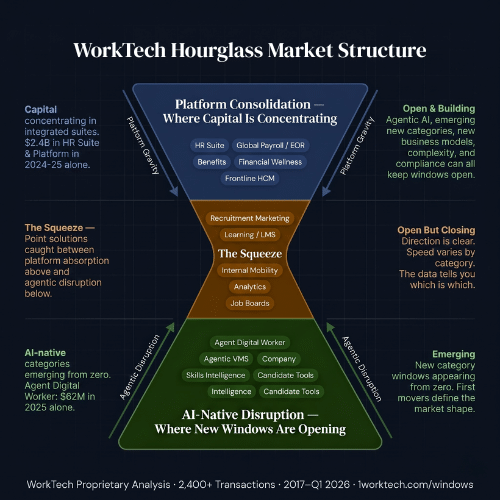
The WorkTech hourglass places the job board and marketplace category at the wide middle of the market structure: not the foundational compliance infrastructure of the Platform Gravity Belt above it, nor the highly specialized point solutions below it. The same forces compressing the middle apply here. With one exception worth naming: the lifestyle business job board serving a genuine niche community still has a window. The local job board with deep employer relationships in a specific geography, the trade-specific platform with real community trust, the vertical marketplace with genuine compliance depth. Solutions like these are not immediately threatened. But their window is closing too, just more slowly than the transactional generalists. The AEO and GEO future racing toward us has a deadline for every job discovery surface. Niche players navigating toward that future have time. The ones ignoring it do not.
In This Report
WORKTECH · Opening & Closing Market Windows · Window Scorecard
Job Boards & Programmatic Advertising
Two categories. One verdict. The model is closing.
Job Board/Programmatic Market Window Scorecard
Funding Data: Closing
The Marketplace Job Board category ranked number one in the WorkTech dataset for three consecutive years: 2017, 2018, and 2019, and remained in the top three through 2023. In 2024, it fell to number eleven. Total investment dropped from a 2021 peak of $2.4 billion to $220 million in 2024, the lowest since 2017. The 2025 partial recovery to $344 million is capital flowing toward emerging models within the category: vertical specialists, outcome-based platforms, candidate-side tools, rather than toward the transactional job board model that defined the peak. Recruitment Marketing, the broader category including programmatic, fell from $475 million in 2021 to $4 million combined across 2024-25. The only category showing new investment momentum is Candidate Tools at zero before 2025, and $50 million across nine deals in 2025 alone. The funding data is not showing a recovery. It’s showing capital forming around the replacement model.
Buyer Trends: Closing
Employer sentiment toward the transactional job board model has deteriorated measurably in 2025 and 2026. ROI scrutiny of job board spend has intensified as hiring volume has declined and cost per hire has risen, despite softer market conditions. Indeed’s own 2026 benchmark data shows employer cost-per-application rising sharply even as the labor market softened, a signal that the volume model is no longer delivering value at the rate it historically did. The response from Indeed? Restricting organic visibility to force sponsored adoption and capping free hosted postings at three per month, compounding the employer ROI problem rather than addressing it. Buyers are not abandoning job boards. They are increasingly questioning whether the spend allocation reflects where the value actually is. The platforms capturing budget are the ones with outcome accountability and depth of candidate quality, not the ones with the most listings.
Adoption Data: Stable, Model Transitioning
Job board adoption as a behavior is not in question. Employers post jobs. Candidates search for them. The transactional baseline persists. What is shifting is the adoption of the model built on top of that baseline. Programmatic job advertising adoption has been largely passive, embedded in ATS integrations and agency retainers, with employers not fully understanding the model or the underlying margin structure. As agentic sourcing tools mature and outcome-based platforms demonstrate measurable hire results, passive programmatic adoption is being replaced by more deliberate purchasing decisions. Buyers who understand what they are buying are increasingly choosing something different from what the traditional programmatic layer provides. Adoption of the replacement models- vertical marketplaces, outcome-based programmatic, agentic sourcing- is early but accelerating.
M&A Activity: Distressed Consolidation
The M&A signal in this category is as clear as the funding data, and it points in the same direction. CareerBuilder and Monster, two of the most recognized brands in the category’s history, merged in September 2024 and filed for Chapter 11 bankruptcy protection by June 2025, with assets valued at $28 million against $392.5 million in debt. The intelligent consolidation is happening at the platform level: Adzuna is building job search, social distribution, and international scale through three deliberate acquisitions. ZipRecruiter adding community value through Breakroom. Stepstone is repositioning its entire 20-plus-brand portfolio toward AI-driven matching under KKR ownership. Veritone assembling Broadbean and PandoLogic into a global distribution and programmatic stack. The distressed consolidation at the legacy end and the strategic repositioning at the platform end are both pointing in the same direction: the transactional model is being wound down or rebuilt into something else.
WorkTech Lens: Closing
The job board and programmatic advertising categories are closing, not because the behavior they serve is going away, but because the business model underneath them is being replaced. The platforms winning in 2025 and 2026 are not building better job boards. They are building outcome-accountable marketplaces, vertical communities with compliance depth, and agentic platforms that deliver intelligence to both sides of the transaction rather than routing traffic between them. Programmatic has a slightly longer tail than the transactional job board because the outcome-accountable model is emerging from within it through VONQ, Joveo, and the agency-owned technology plays. But the volume-dependent, click-arbitrage model that defines most programmatic spend today is on the same trajectory. The emerging marketplace model: candidate-first architecture, outcome accountability, agentic intelligence, and vertical depth, is the open window. The transactional model is the closing one.
WORKTECH · Opening & Closing Market Windows · The Funding Picture
The Funding Cliff: Marketplace Job Board Investment 2017–2026
Six years at or near the top of the WorkTech capital flow rankings — then a collapse that is not a correction
Category Rank in WorkTech Dataset by Year
The Funding Picture
The WorkTech dataset tracks 2,400-plus transactions across 65-plus categories from 2017 through Q1 2026. The Marketplace Job Board category tells one of the clearest stories in the entire dataset.
$7.8B
Total investment in Marketplace Job Board category across 8 years | 428 deals
The category was the top-funded in the WorkTech dataset for three consecutive years: 2017, 2018, and 2019. It remained in the top three through 2023. Then 2024 arrived, and the category fell to number eleven. Total investment that year: $220 million. In 2019, it had been $1.09 billion.
The peak was 2021 at $2.4 billion. The years that followed told the story of a category searching for its next form. 2022 brought $1.1 billion. 2023 brought $758 million. 2024 brought $220 million. 2025 saw a partial recovery to $344 million, but that recovery the category, not toward the transactional job board model that defined the peak.
The broader Recruitment Marketing category, including employer branding, candidate attraction, and programmatic job advertising, peaked in 2021 at $475 million. Combined 2024-25 investment was $4 million. Programmatic job advertising, a subset of that category, faces its own structural pressures, which are covered in depth in the Programmatic Layer section below.
The Candidate Tools subcategory tells the opposite story. Zero investment before 2025. Nine deals totaling $50 million in 2025 alone. That is a brand-new investment thesis emerging in real time: the candidate side of the marketplace, treated as an afterthought by the traditional job board model for 30 years, is beginning to attract dedicated capital. Whether this becomes its own category or represents acquisition targets for platforms seeking to close the candidate experience gap remains an open question. Either way, the signal is clear.
WorkTech Lens
What the trend tags tell you that the dollar totals do not: AI plus matching is the dominant 2024-25 investment thesis, not job board distribution. Vertical specialization is accelerating while generalist funding contracts. Outcome-based pricing is appearing explicitly in deal descriptions for the first time in this category. Community and network plays are finding capital where pure transactional plays are not. The funding data is not showing a down market in job boards. It is showing the capital forming around the replacement model.
The distinction between these two models is the most important framework for reading every investment, acquisition, and platform decision in this category, and it runs through everything that follows.
WORKTECH · Opening & Closing Market Windows · The Model Shift
Two Models. One Market. One Window Closing, One Opening.
The job board market is not contracting — it is splitting. Which side of this divide a platform sits on determines its trajectory.
The M&A Verdict
The clearest window signal in this category isn’t a funding round. It is a bankruptcy filing.
Legacy Consolidation Into Bankruptcy
CareerBuilder and Monster completed their merger in September 2024, bringing two of the most recognized job board brands in the world together under Apollo Global Management with Randstad maintaining a minority stake. The thesis was consolidation for scale. The outcome was Chapter 11. By the time the combined entity filed for bankruptcy in June 2025, revenue had plummeted to $49.2 million — a 40% decline from the prior year — while carrying approximately $392.5 million in debt. Bold Holdings, founded by two former Monster executives, won the core job board assets at $28 million, narrowly outbidding JobGet’s $27 million. Bold brings a candidate-side career services portfolio including Zety, FlexJobs, ResumeBuilder.com, and is building distribution on top of the distressed assets. An April 2026 federal antitrust complaint filed by Rocket Resume against Bold and related entities (Case No. 5:26-cv-02852, N.D. Cal.) adds a legal dimension worth watching, though the allegations have not been tested in court and Bold had not issued a public response at the time of publication. The bankruptcy and the acquisition don’t represent a market force reshaping this category. They represent the verdict on a model.
JobGet: Consolidating to Build Something Different
JobGet’s acquisition run since early 2024 is one of the more strategically coherent stories in this category. Before bidding on CareerBuilder and Monster, JobGet had already acquired Snagajob, Seasoned, and Wirkn, consolidating job-seeker volume in the hourly and frontline workforce segments and building platform value on top of that distribution. The distressed-asset strategy funds a vertical-specialization play at below market prices.
Adzuna: The Intelligent Consolidator
While CareerBuilder and Monster were consolidating desperately, Adzuna was consolidating deliberately. Three acquisitions in four years, each addressing a specific gap in a defined platform roadmap. Getwork in 2022 brought US enterprise job search. Seiza in November 2024 brought social media recruitment advertising with over 400 enterprise clients, reaching passive candidates across Facebook, Instagram, Snapchat, and TikTok. Trovit Jobs and Mitula Jobs in March 2026 brought coverage across 50-plus countries with particular strength in Spain, Italy, and Latin America. Each deal connects to the next in a coherent strategy. The contrast with CareerBuilder and Monster is the difference between consolidation as survival and consolidation as strategy.
ZipRecruiter: Right Instinct, Revenue Headwind
ZipRecruiter’s acquisition of Breakroom in August 2024, a UK-based employer review platform built around community-powered ratings for frontline jobs, shows the right strategic instinct. Adding genuine candidate value and community credibility to the job marketplace is exactly the transformation major brands need to make. The constraint is the revenue model. ZipRecruiter’s core business remained fundamentally tied to cost-per-click job advertising in a market where seasonally adjusted hires declined year over year for 28 consecutive months, outpacing the Great Recession of 2008. The transformation is underway and incomplete simultaneously.
The Global Breakup
Adevinta, the Norwegian classifieds giant, was taken private by Permira and Blackstone in May 2024. Its Spanish operations, including InfoJobs, were subsequently sold to EQT for a reported 2 billion euros. RedArbor, the Spain-based operator, acquired Catho in Brazil and OCC in Mexico, building a pan-Latin American network with local compliance infrastructure in each market. Regional compliance, local brand trust, and employer network depth still command significant valuations in markets where Indeed and LinkedIn have not fully displaced local platforms.
WorkTech Lens
The M&A signal in this category is as clear as the funding data. The transactional model is not being acquired at premium — it is being liquidated at a fraction of its historical value. The intelligent acquirers are not buying job boards. They are buying distribution, communities, and data to build something the job board model never was: outcome-accountable, candidate-side-valued, and vertically deep.
The Major Brands: Platform Gravity With a Revenue Problem
Indeed, LinkedIn, ZipRecruiter, and the major international job board brands have something most of the market does not: scale, brand trust, and employer relationships built over decades. That is genuine platform gravity. It buys them a three to five-year runway that smaller transactional job boards do not have.
But the revenue model is the structural constraint that platform gravity cannot fully offset. And there is a deeper problem with how that revenue model was built, one that goes beyond the cyclical pressure of a slow hiring market.
How the Aggregation Model Created the Problem It Now Has to Solve
Indeed built its position through aggressive aggregation, scraping jobs from everywhere, pulling in listings from company career sites and every other available source, building the largest job inventory available anywhere online. The strategy worked brilliantly for getting employers onto the platform. It worked less well for the people actually using it.
The model that followed was familiar from B2C and B2B digital advertising: build massive audience, then sell visibility within that audience. Promoted listings, sponsored jobs, featured placements. In digital product marketing, that model works cleanly. You are selling visibility for a product to a consumer who has indicated interest. The transaction is between a brand and a buyer.
In job search, the transaction is between a human being and a livelihood. Promoting sponsored jobs over the most relevant jobs does not serve the candidate. It serves the advertiser. When the market was growing and volume was abundant, that tension was largely invisible. When hiring slowed and quality became the priority over volume, the tension became the central problem. Candidates began receiving a worse matching experience in exchange for employers buying visibility. Employers began questioning whether the spend was generating hires or generating applications that went nowhere.
Employer complaints about Indeed’s performance have accelerated in 2025 and 2026, with many questioning the ROI of sponsored placements against declining hire rates. The platform’s response has been to double down. As of December 2025, Indeed capped free hosted job postings at three per employer per calendar month across the US, Canada, UK, Germany, and the Netherlands. As of March 31, 2026, Indeed eliminated free organic visibility for jobs sent through single-source XML or API feeds that do not use an ATS integration with Indeed Apply — a policy change that restricts organic reach to force employers into sponsored placements or compliant ATS integrations. The platform that built its position on aggregation is now using that position to extract more from employers, at the precise moment when employer ROI scrutiny is at its highest. That is not a transformation. It is a revenue model defense — and it compounds the very problem the platform needs to solve.
In June 2026 Indeed published a policy statement titled “Setting Expectations Amidst a Changing Landscape” framing its direction as a job-seeker-first philosophy built around quality, trust, and ecosystem partnership. The actual content of the announcement tells a different story. “The more you invest in Indeed, the more you get out of Indeed” is the central commercial principle stated explicitly. Employers who pay more get more visibility. Employers who do not, get less. The announcement also notes that employer budgets “may spend faster” and will “receive fewer, yet higher quality, candidates at a faster pace,” which is a price increase framed as a quality improvement. Taken together with the December 2025 free posting cap and the March 2026 XML feed organic visibility cutoff, the direction is consistent:
Indeed is systematically converting the free distribution model that built its market position into a pay-for-performance model that extracts more from the employer relationships that position created. Whether that produces a better candidate experience or simply a more profitable one is the question the market will answer over the next six to twelve months.
The Programmatic Parallel
Appcast did something similar at its launch. It took a model that was trending in B2C and B2B marketing, programmatic advertising, buying impressions algorithmically across a network of destinations, and applied it to job advertising. In commercial digital marketing, the destination set for programmatic ads is vast: news sites, social platforms, content networks, apps. The advertiser reaches consumers wherever they are.
In job advertising, the primary destinations for programmatic spend are job boards. And job boards are themselves part of a massive aggregation chain, getting paid and paying each other per click, with the same listing often appearing on dozens of platforms simultaneously. Appcast drives a significant portion of its revenue through Indeed, making the two businesses deeply interconnected. When the market shifted toward quality over volume, the programmatic model, built on click throughput across a board network, delivered diminishing returns to employers while compounding the experience problem for candidates.Both Indeed and Appcast are technology businesses that applied digital advertising logic to the job market. The logic worked when growth was the measurement. It is working less well when outcomes are the measurement. The difference between connecting inanimate products to buyers and connecting human beings to their livelihoods is not a philosophical distinction. It is the core product and business-model problem that both companies now have to solve.
LinkedIn is the furthest along the transformation path of any major brand in this category. The combination of the world’s largest professional network, LinkedIn Learning, Recruiter, Talent Insights, salary data, skills verification, and the Hiring Assistant, which went generally available in September 2025, represents the most complete platform transformation in the job board space so far. The Hiring Assistant is LinkedIn’s first production AI agent for recruiters: sourcing, screening, and scheduling built into the recruiter workflow rather than layered on top. The honest constraint: LinkedIn’s network skews professional, white collar, and credentialed. The frontline workforce, skilled trades, hourly workers, and the blue- and gray-collar segments that represent the largest share of unfilled jobs in the US economy are not LinkedIn’s market.
The Stepstone Group: The Most Underreported Story in Global Job Boards
The Stepstone Group is not a European job board with a US programmatic investment. It is the world’s largest job board portfolio outside Recruit Holdings, operating more than 20 brands across more than 30 countries. The brand portfolio spans every major non-US market: Stepstone Deutschland as Germany’s number one job board, with Stepstone Belgium, France, the Netherlands, and Austria covering Western Europe. In the UK, Totaljobs anchors a portfolio that also includes Jobsite, CWJobs, CareerStructure, CityJobs, eMedCareers, Just Engineers, Milkround, and RetailChoice. In Ireland, IrishJobs.ie, Jobs.ie, and NIJobs.com. In South Africa, both Pnet and CareerJunction. In Central America and the Caribbean, Tecoloco across 10 markets, EstasContratado, and Caribbean Jobs. In the US and Canada, Appcast. In employer branding, Universum. In early career, Studydrive and Milkround.
KKR and CPP Investments acquired a majority stake in the Stepstone Group in 2024, repositioning it from a job board network to an AI-driven matching platform that processes 100 million applications annually. The structural pressure on Appcast’s US revenue model needs to be understood in this context. Appcast was acquired by Stepstone in 2019. The pandemic-era remote hiring surge from 2020 through 2022 occurred entirely during Stepstone’s ownership period.
Appcast was never integrated into the broader Stepstone portfolio, operating as a US-only platform. Stepstone did not expand the programmatic model into its European markets or apply Appcast’s technology to the global remote hiring opportunity when that window was open. That missed integration is one of the most consequential strategic decisions in the recent history of the global job board market.
A Note on AI-Native Entrants
Several AI-native platforms are entering the talent connection market with matching and placement approaches that challenge the traditional job board model. OpenAI has announced a Jobs Platform targeting mid-2026, focused specifically on connecting employers with AI-skilled talent through a certification program and AI-driven matching. The announcement is credible. The platform is real.
What is not yet credible — based on available evidence — is the broader claim that this represents an immediate general-purpose disruption to the job board market. The demos shown publicly to date have been narrow in scope. The model of requiring candidates to install employer-specific applications is not scalable at the general job market level. The history of technology companies applying consumer product logic to the job market suggests appropriate caution about assuming that AI capability alone translates to a better human experience in talent matching. The WorkTech position is: a briefing and firsthand evidence before that threat gets the weight some in the market are already assigning to it.
WorkTech Lens
The major brands are not losing this market this year or next year. But the three to five year runway they have is not a safety margin. It is a deadline. The revenue model problem is not cyclical. It is structural. The brands that use that runway to build genuine outcome accountability, candidate-side value, and agentic intelligence into their core product will emerge stronger. The ones that optimize the existing model while building incrementally around the edges will find that the runway ended while they were still planning the transformation.
The ATS-Adjacent Marketplace: The Opportunity and the Market Lesson
One of the most interesting structural opportunities in the job board and marketplace category is the ATS-adjacent layer. A candidate portal or job discovery destination built in close proximity to the hiring workflow, positioned to deliver candidate value and employer value simultaneously from a position of privileged data access.
The ATS already knows which jobs are open, which candidates are in the pipeline, and how the hiring process is progressing. A candidate-facing layer built on top of that data could give candidates genuine transparency, real application status, and a reason to prefer the experience over navigating to Indeed. Employers whose candidates apply through a well-designed, candidate-first portal get higher-quality applications and a better candidate experience. The candidates get the transparency and communication the black hole job board model has never provided.
Greenhouse is building the proof of concept. myGreenhouse, its candidate-facing portal, is succeeding because Greenhouse built from the candidate in rather than from the employer workflow out. Candidate value is the primary design constraint. The product gives candidates genuine visibility into their application, real-time status, and a reason to prefer the Greenhouse-powered experience over alternatives. Applications per recruiter on Greenhouse spiked 412% since 2023, a signal of both the volume problem the market faces and the platform’s position at the center of it. Greenhouse’s acquisition of Ezra AI Labs in May 2026, a voice AI interviewer built on the same structured, candidate-transparent principle, signals that the platform sees voice as the next interface layer at the top of the funnel, a natural extension of the candidate-first architecture myGreenhouse was built on.
Previous attempts at the ATS-adjacent marketplace failed precisely because they inverted that logic. One notable example from a major ATS provider, a dedicated candidate portal and centralized job discovery environment, was discontinued due to lack of traction. The candidate experience problems that emerged were symptomatic of a more fundamental model failure. The portal was a job board bolted onto an ATS. It served the employer’s need for centralized distribution. It gave candidates no genuine value they could not get elsewhere. Without candidate value, there is no candidate volume. Without candidate volume, there is no employer value. The model failed at its foundation.
The ATS-adjacent marketplace opportunity is real and growing. The object lesson is that capturing it requires starting from the candidate value proposition, not the employer workflow. Platforms that build with candidate experience as the primary design constraint are the ones building toward the open window in this layer.
WorkTech Lens
The architecture of a marketplace — who it is built for, what value it delivers, and which side of the two-sided market is treated as the primary constituency — determines its competitive trajectory more than any other design decision. The ATS-adjacent layer is a genuine open window. It will be won by the platform that builds it from the candidate in, not from the employer out.
The Programmatic Layer: Bifurcating Fast
Programmatic job advertising is a subset of the broader recruitment marketing category. The technology layer that automates the distribution of job ads across a network of boards and sites, optimizing spend algorithmically based on performance data. It is not dying. It is splitting, and the split is happening faster than most platforms have ever had to adjust to.
WORKTECH · Opening & Closing Market Windows · The Programmatic Layer
The Programmatic Layer Is Not Dying. It Is Splitting.
Platforms delivering outcome accountability and agentic screening are capturing value. Platforms dependent on job ad volume face compression from both sides.
The Legacy Infrastructure Layer: eQuest and Broadbean
Before examining where the programmatic layer is heading, it is worth noting the infrastructure it was built on top of. eQuest was founded in 1994 and celebrated its 30th anniversary in January 2024, having processed nearly two billion job posting actions over that period. The majority of Fortune Global 1000 companies trust eQuest to post jobs worldwide through integrations with Workday, Jobvite, and dozens of other major ATS platforms. Whatever market share eQuest has ceded in recent years, Broadbean has largely absorbed. Broadbean, now part of Veritone Hire, still operates the straight job posting and distribution model at enterprise scale across 180 countries and 3,000-plus clients. Both represent the foundational infrastructure: the original job distribution rails that the programmatic optimization layer was built to run on top of. That infrastructure remains deeply embedded in enterprise ATS integrations regardless of what the model above it is doing.
Appcast and Bayard: Technology Plus Services, Under Pressure
Appcast’s acquisition of Bayard Advertising in July 2023 was a direct response to the market pressure the programmatic-only model was already facing. The combination of algorithmic job ad distribution with employer branding, media buying, and recruitment marketing strategy capabilities was a recognition that neither technology nor services alone was sufficient.
That acquisition was also the domino that started a competitive response across the market. Shaker Recruitment Marketing, a full-service US recruitment marketing agency with 75 years of history, responded by acquiring JobAdX in early 2025, integrating programmatic technology directly into its capabilities. The JobAdX founder was appointed VP of Programmatic Technology. Shaker now owns its programmatic stack rather than depending on third-party platforms.
Appcast’s founder has publicly downplayed this competitive threat. The WorkTech read is that it is being underestimated. The compound effect of AI displacing programmatic ad revenue from above while agency-owned technology competes for the programmatic budget from below will be more significant than the public commentary has acknowledged. Appcast has never been integrated into the broader Stepstone portfolio, operating as a US-only platform throughout the ownership period. That context matters for understanding where the business is today.
Veritone Hire: PandoLogic, Broadbean, and the Portfolio Question
Veritone acquired Broadbean from CareerBuilder in 2023 for $52 million, a global job distribution platform serving 3,000-plus clients across 180 countries, integrated with over 100 ATS partners. Combined with PandoLogic under the Veritone Hire umbrella, the portfolio covers programmatic advertising plus global job distribution. The Job Acceleration product launched in May 2026 within the Broadbean by Veritone platform. The open question is strategic direction: Veritone’s parent company’s direction has moved toward enterprise AI software and public sector technology. Whether the talent acquisition portfolio receives the sustained investment required to compete on the outcome-accountable model is the question the market cannot yet answer.
VONQ: The Outcome Model, With a Go-to-Market Constraint
VONQ describes itself as a next-generation agentic AI recruitment technology company. The CPA+ product delivers cost-per-applicant pricing through ATS-native workflows with agentic AI screening built in, targeting 100,000-plus hiring companies through its HAPI distribution network. The SAP SuccessFactors integration launched in January 2026. The EQO suite adds AI agents for candidate screening and conversational assessment on top of the distribution platform.
In Europe, VONQ sells directly to enterprise employers. It owns the relationship, has direct access to employer hiring data, and can deploy agents at the top of the funnel where they need to operate. In the US, the model has been ATS-partner-only, which means VONQ sits behind the ATS in the workflow rather than owning the employer conversation. Agentic go-to-market requires owning that top-of-funnel relationship. That is not a product problem. It is a go-to-market architecture problem, and the agentic model makes it more acute, not less.
Joveo: Organic Growth Toward the Right Model
Joveo’s reported revenue trajectory reflects consistent organic growth: $6.5 million in 2021, $12.8 million in 2023, $16.2 million in 2024. The $10 million raised in August 2024 funded a product roadmap that includes Unified Analytics combining recruitment marketing, sourcing, and ATS data in a single view; TalentNeuron labor market intelligence integration; a Conversational AI recruiting assistant with in-chat application capability; an AI Staffing Advisor for staffing firms; and an AI Career Site Builder. In March 2026 Joveo acquired We Are Yoke, a recruitment marketing agency, the same agency-plus-technology thesis playing out across the programmatic layer. Building toward the same outcome-based and agentic model as VONQ from a US-native, staffing-focused starting point.
WorkTech Lens
The programmatic bifurcation is the clearest current example of the broader article thesis. Outcome accountability and agentic screening are the open window. Cost-per-click volume distribution is the closing one. Platforms on the wrong side of that split face structural compression from both directions simultaneously: declining job ad volume from above, agentic sourcing displacement coming from below. The window to reposition is still open. It is not open indefinitely.
The Emerging Model: Outcome, Agentic, Value-Add
Every significant 2024-25 deal in this category is moving in the same direction. Not toward better job boards. Toward a fundamentally different model, one where the platform delivers outcome accountability to employers, genuine value to candidates, and intelligence to both rather than simply aggregating listings and routing traffic.
The Funded Plays
Optimhire ($5M, 2025) takes results-based pricing as its explicit go-to-market positioning. Employers pay for outcomes. That is a direct statement of the model thesis that the programmatic layer is trying to build toward from a more complex starting point.
Shakers (14 million euros, Series A, 2025) is a Madrid-based workforce orchestration platform, unrelated to Shaker Recruitment Marketing, the US-based recruitment marketing agency. Shakers connects businesses with vetted freelance tech specialists and autonomous AI agents. The Spanish platform, works with over 450 companies including Microsoft, Inditex, and Telefonica, hosting 10,000-plus vetted tech freelancers, and has grown revenue more than 6x in the past year. It is building from the agent and the vetted talent community up rather than from the listing and distribution infrastructure down.
Job&Talent (92 million euros Series F, 2025, 1.3 billion euros valuation) is the European frontline marketplace unicorn. In 2024, Job&Talent placed over 300,000 workers in more than 3,250 companies across logistics, warehousing, and retail, operating across 10 countries in Europe, the US, and Latin America. The Series F funds AI agents trained on data from over one million real worker placements and millions of logged shifts. In 2025, Job&Talent announced it would extend its AI platform to include permanent workers, not just temporary staffing. This is not a job board with AI features. It is a workforce management platform with AI-native matching built from the ground up on real operational data.
The WorkTech dataset also captured a 2025 funding round for Mercor. Mercor has since pivoted primarily toward placing LLM trainers rather than operating as a commercial general-purpose talent marketplace. It is noted for its funding record rather than as an active commercial platform in the broader talent-connection market.
The Candidate Tools Signal
The most structurally important data point in the 2025 and 2026 funding landscape is a category that did not exist in the WorkTech dataset before last year. Candidate Tools attracted $50 million across nine deals in 2025. All of that investment in a single calendar year, with zero in any prior year.
Jack & Jill ($20M), Teal ($8M), Final Round AI ($7M), Dex ($3M), described as an AI Voice Candidate Agent), and five additional seed-stage plays represent a new investment thesis: the candidate side of the talent marketplace, ignored or treated as a distribution channel by the traditional job board for thirty years, is beginning to attract dedicated capital. Whether this becomes a standalone category or represents acquisition targets for platforms needing to close the candidate experience gap, the signal is unambiguous.
The structural implication is significant. When employers have AI agents sourcing candidates and candidates have AI agents searching for jobs, the platform in the middle that adds no intelligence is being disintermediated from both sides simultaneously. The traditional job board’s value proposition was information aggregation and distribution. AI is replacing information aggregation. The question is what the platform provides when that function is automated.
The Untapped Intelligence Layer
Lightcast has 18 billion labor market data points: skills demand, earnings benchmarks, occupation-level trajectories, real-time job posting analytics. Geographic Solutions powers the American Job Center network through its Virtual OneStop platform, holding decades of placement and outcomes data flowing through the public workforce system. Indeed has the largest job posting dataset in the world. LinkedIn has the largest professional network and the most granular skills graph available.
None of the marketplace job boards have meaningfully made that intelligence available to AI agents at the point of decision, the moment a candidate is evaluating a role or an employer is evaluating a candidate. The data exists to make every job connection more intelligent. The infrastructure to deliver it through agents at the point of need is not yet built. That is an open window. The platform that builds agent-accessible labor market intelligence into the job connection workflow is building something that neither the legacy job boards nor the newer entrants have fully assembled yet.
WorkTech Lens
The job board that wins the next decade is not the one with the most listings. It is the one that makes its data accessible to agents, delivers outcome accountability to employers, builds genuine value for candidates rather than routing them as traffic, and embeds the intelligence layer that makes every connection more valuable than what either party could achieve without the platform. That is a fundamentally different product than a job board. It is also the only product that will be defensible when AI agents are operating on both sides of the marketplace simultaneously.
The Vertical Specialization Thesis
The most defensible position in the job board category is not the biggest brand. It is the deepest community. The vertical specialists with genuine compliance depth, employer network density, and candidate trust within a specific segment are building moats that major brands cannot quickly replicate, regardless of the capital available.
WORKTECH · Opening & Closing Market Windows · Vertical Specialization
The Deepest Community Wins. Not the Biggest Brand.
Every funded vertical play in 2024-25 combines community, compliance, or training with job connection — not listings alone.
Healthcare: The Compliance Moat
Healthcare job matching is not primarily a talent connection problem. It is a compliance and credentialing problem that requires a technology layer to manage. Clinical licensing verification, specialty credentialing, geographic practice authorization, shift management for variable-hour clinical staff, and immigration compliance for international healthcare hiring are all requirements that generic job boards were not built to handle.
ShiftMed ($47M, 2024) and Nomad Health ($56M across 2024-25) are building into the compliance and credentialing layer, not just the listing and distribution layer. Tern Group ($24M, 2025) extends the healthcare hiring model internationally, combining clinical placement with immigration compliance infrastructure. These are not healthcare job boards. They are healthcare workforce compliance and deployment platforms that happen to connect talent to jobs.
Skilled Trades: The Most Underserved Segment
The skilled trades workforce is simultaneously the segment most resistant to AI displacement, most chronically underserved by traditional job boards, and most urgently needed by the US economy. The skilled trades labor shortage is not a short-term cyclical phenomenon. It is a structural gap between the workforce supply the education system produces and the workforce demand the physical economy requires.
Smalt ($9M, 2024) combines trades hiring with training, addressing the pipeline problem rather than just the matching problem. VeroSkills ($5M, 2025) and UpSmith ($5M, 2024) are building the talent management infrastructure for trades employers. Rivet ($6M, 2024) is building full talent management and workforce management for the trades sector.
Frontline and Hourly: Converging With the Platform Gravity Belt
Job&Talent, WorkWhile, Instawork, and Homebase are all competing in the frontline and hourly workforce segment, and all are building toward a model where the job connection is the entry point into a broader workforce management and financial services relationship. Scheduling, compliance, and earned wage access are converging with job matching in this segment. The frontline marketplace is pulling toward the Platform Gravity Belt from the TA side, a convergence with significant implications for how investors and CHROs and Talent Acquisition Leaders should think about both categories together.
Community and Purpose-Built Networks
Jobcase — 110 million registered members, $148 million raised, Workday Ventures as a strategic partner, last external raise in 2020, built the community model for blue and gray-collar workers before the segment became a competitive priority. The open question is whether the head start translates to a durable moat as JobGet, WorkWhile, Instawork, and Job&Talent arrive with more recent capital and more aggressive product roadmaps.
ZipRecruiter’s acquisition of Breakroom positions it as a community-credentialed player in the frontline segment — employer ratings built from worker feedback, not employer marketing copy. Whether the transformation runs deep enough to change the revenue model is the open question.
RallyPoint ($9M, 2024) is the veteran community and job connection platform. Community-first, not listings-first, with the network depth that comes from serving a specific community with specific needs that generic platforms do not address.
WorkWeek ($12M, 2025) is building a professional community and job connection on top of content and network in specific industries, where content credibility creates the trust that makes the job connection valuable.
WorkTech Lens
Every funded vertical play in 2024-25 combines community, compliance, or training with job connection, not listings alone. The vertical job board with no community moat, no compliance depth, and no training or credential layer is the closing window inside the vertical specialization thesis, not the open one. Vertical focus is necessary but not sufficient. The moat requires something the major brands cannot replicate quickly: local expertise, compliance infrastructure, employer network density, or community trust built over years serving a specific segment.
The Freelance Marketplace Boundary
Upwork and Fiverr are not job boards. But they occupy the outer boundary of the talent connection market, the layer where the distinction between employment and independent work is dissolving, and the divergence between their 2024-25 performance is the clearest preview available of where the broader job connection category is heading.
Upwork reported record revenue in 2024 and $1.3 billion in revenue for 2025. AI-related work grew 60% year-over-year in 2024. Freelancers doing AI projects earned 44% more per hour than other freelancers. The platform holds above 61% market share among major freelance marketplaces with over $4 billion in annual Gross Services Volume. The Uma AI assistant launched in 2024, embedding AI into the freelancer workflow rather than competing with it.
Fiverr projected revenue of $422-428 million for 2025 and reported a record 21.3% adjusted EBITDA margin. But active buyer count dropped 10% in 2024, creating a tension between improving economics per buyer and a shrinking overall user base. Fiverr Go launched, allowing freelancers to build AI models trained on their own work, an attempt to position freelancers as AI-enabled rather than AI-replaced.
WorkTech Lens
The Upwork and Fiverr divergence maps directly onto the central thesis of this article. Upwork is winning because AI created new categories of high-value, judgment-intensive work that require human expertise and command premium rates. Fiverr is navigating headwinds because its model was historically weighted toward commodity gig work that AI is displacing directly. The job board market is playing out the same dynamic one layer above: platforms connecting talent to high-value, outcome-accountable work are building. Platforms in the commodity connection transaction business are closing. The direction is the same. The timeline varies by segment and market maturity.
The Geographic Dimension
The job board market is a global story told in four chapters. Indeed, LinkedIn and ZipRecruiter operate as major brands across most of them, but with different competitive positions, revenue model pressures, and runways in each chapter. Understanding the geographic dimension is essential to reading the window correctly: the structural transition is not happening uniformly, and the open windows in this category are not where most analysts are looking.
WORKTECH · Opening & Closing Market Windows · The Geographic Dimension
Four Chapters. One Category. Different Stages of the Same Transition.
The structural shift is not happening uniformly. The open windows are not where most analysts are looking.
North America: The Consolidation Chapter
The most mature market. The most capital-intensive. The most structurally challenged by the revenue model transition. The CareerBuilder and Monster bankruptcy is the verdict on the transactional model at scale in its home market. JobGet and Bold are recycling the distressed assets into new models. ZipRecruiter is mid-transformation. Appcast under Stepstone ownership faces structural pressure from both the declining job ad volume market and the programmatic model transition.
Indeed holds a dominant market position. 77.5% of US job seekers name it as their primary job search platform. But the aggregation model that built that position is now under structural pressure from employer ROI scrutiny and deteriorating candidate experience. LinkedIn is furthest along the platform transformation path but is concentrated in knowledge-worker and credentialed segments. ZipRecruiter is making the right moves against a challenging revenue backdrop.
The consolidation in North America is not creating stronger job boards. It is creating the conditions for the model to be replaced.
Europe: The Challenger, Compliance, and Portfolio Chapter
The Stepstone Group’s 20-plus brand portfolio across 30-plus countries is the defining story in European job boards. In DACH, Stepstone Deutschland is Germany’s number one job board. In the UK, Totaljobs anchors a portfolio that also includes Jobsite, CWJobs, and seven additional specialized brands. IrishJobs.ie, Jobs.ie, and NIJobs.com cover Ireland and Northern Ireland. The KKR majority acquisition and AI-driven matching repositioning is the most significant ownership and strategic shift in the global job board market of this period. Stepstone’s portfolio extends well beyond Europe, with Pnet and CareerJunction in South Africa and Tecoloco across 10 Central American markets, covered in their respective geographic sections below.
Beyond the Stepstone portfolio, the UK market includes Reed, the country’s first online employment site with the largest web traffic share among UK boards, and CV-Library, which distributes across 800-plus partner boards with a 17 to 21 million CV database. In Italy and Southern Europe, Jobrapido, an Italian-founded aggregator operating in 58-plus countries, and Careerjet, aggregating from 70,000-plus websites across 90 countries in 28 languages, represent the aggregator model at continental scale. Jooble, the Ukrainian-founded platform aggregating from 140,000-plus sources globally, carries a distinctive identity from its decision to cease operations in Russia and Belarus following the 2022 invasion and its Give a Job for UA initiative supporting Ukrainian refugees.
The EU compliance environment is the most active regulatory driver in European job boards: the Pay Transparency Directive requiring implementation by 2026, the Platform Work Directive reshaping gig and contractor classification, GDPR as the ongoing data governance layer, and the EU AI Act employment provisions. Each is generating technology mandates that local platforms with compliance infrastructure are better positioned to serve.
Asia-Pacific: The Platform Gravity, Infrastructure, and Scale Chapter
SEEK is the dominant story in APAC job boards. SEEK captures 90% of total time spent on job sites in Australia, generated AUD $1.1 billion in revenue in 2025, and holds a 4.9x placement share lead over its nearest competitor. SEEK’s portfolio approach, holding investment stakes in JobsDB, JobStreet, Jora, JobKorea, Zhaopin, and JobAdder across APAC, is the most sophisticated geographic strategy in the global job board dataset. The Sidekicker reacquisition in 2025 added staffing-marketplace capabilities alongside the core job board.
In China, Zhaopin and 51job command over 300 million resumes combined. No Western platform has meaningfully penetrated mainland China hiring. In India, Naukri.com remains the undisputed leader in tech, IT, and general corporate hiring. Naukri launched Naukri Campus in April 2024, building toward the early career segment. In Japan, Recruit Holdings, parent company of Indeed and Glassdoor globally, has deep roots in the Japanese job market through its domestic businesses. Japanese labor law complexity creates a localization moat that generic global platforms have consistently struggled to clear. In Southeast Asia, Glints is building a regional talent ecosystem across Singapore, Indonesia, Vietnam, and Taiwan. Taiwan’s 104 Job Bank is the go-to platform for the local workforce.
Mexico and Latin America: The Consolidation, Compliance, and Emerging Infrastructure Chapter
Mexico is the most immediately significant emerging market in the LATAM job board space. OCCMundial, held in the SEEK investment portfolio, is Mexico’s leading job board with deep local compliance infrastructure for IMSS, INFONAVIT, profit sharing, and the 2019 labor reform outsourcing requirements. CompuTrabajo leads across Colombia, Peru, Ecuador, and Central America. Bumeran operates across Argentina, Mexico, Chile, and Peru. Stepstone operates Tecoloco across 10 Central American markets and EstasContratado and Caribbean Jobs in the Caribbean.
Brazil has the most complex payroll and hiring compliance environment in Latin America. Catho and InfoJobs, now under RedArbor and EQT respectively, are the primary corporate hiring platforms with native Brazilian compliance infrastructure. Buk ($50M, 2025) is building the pan-LATAM HR platform with job-connection built in – the same Platform Gravity Belt thesis applied to the LATAM market. The nearshoring trend is creating demand for compliant hiring infrastructure in markets where the technology layer has historically been thin.
WorkTech Lens
The geographic picture tells the same story as the funding data. There are different factors and nuances in each chapter, but they converge on the same conclusion. The markets where the transactional model matured first are under the most structural pressure. The markets where they have not yet matured are the open windows. The window in emerging markets is not for a generic aggregator with global distribution. It is for the platform that builds local compliance infrastructure first, achieves employer network density second, and earns candidate trust through genuine outcome data third.
Service as Software in TA
The HR tech buyer is stuck. Nowhere is this more real than in TA. According to Aptitude Research, 69% of companies report using AI in some capacity in talent acquisition, yet only 18% use it broadly across TA processes. Nearly half have no governance framework in place. Only 15% of employers are very confident AI reduces bias, and only 10% always receive transparency from their AI tools. These are not buyers choosing between two solutions. They are stuck before they get that far, caught between the pressure to act and the fear of making a costly mistake in a market where vendor promises routinely outpace operational delivery.
The platforms winning in this environment are not the ones with the best job board technology. They are the ones combining technology with expertise and accountability. The forthcoming WorkTech Buyer’s Dilemma report establishes the full framework. Two examples of Service as Software operating in the TA market today are the clearest proof points available.
WORKTECH · Opening & Closing Market Windows · Service as Software in TA
Expertise First. Platform Native.
The frozen buyer does not need more software. They need a partner who has built and operated what they are selling — and whose model is tied to outcomes, not seat counts.
Part 1: The Agency Model — HireClix
HireClix was founded in 2010 as a recruitment advertising agency. What it has built since is the clearest example in the TA space of the Service as Software model operating as intended: expertise generating technology, technology scaling expertise, accountability baked into the commercial relationship from the start.
The HireClix career site offering is purpose-built technology and WorkTech analyst validated. Not a templated website with recruitment-specific fields dropped in. Integration infrastructure connects to any ATS natively. A growing suite of proprietary features is built from observed candidate behavior data in live client campaigns running at enterprise scale every day. Analytics connect career site performance to sourcing metrics and ATS data in a single view that most point solutions cannot replicate because they do not own the full stack.
The product launch cadence tells the technology investment story: Employer Brand Network in September 2023; Advanced Analytics Dashboard combining advertising, sourcing, and ATS data in September 2024; Maps for Career Sites in September 2024; Recruiter Hub in October 2025; Quick Apply in January 2026, driven by HireClix’s own research finding that 36% of job seekers abandon applications due to length or poor navigation; JobFlow SEO in April 2025; JobFlow AEO in April 2026.
JobFlow AEO deserves specific attention. Answer Engine Optimization structures client job postings and employer brand content so AI engines can interpret, summarize, and present them as direct answers to candidate queries across ChatGPT, Claude, Gemini, and Perplexity. The Career Site Buyout Program launched in May 2026, covering remaining competitor contract costs to enable employers stuck in underperforming legacy contracts to move immediately.
Ninety Nine Restaurant and Pub achieved a 122% increase in applications year-over-year and 700% greater visibility on Google and AI agents in two months following a career site transformation with HireClix. That is a production outcome from a platform built by an agency running live campaigns for enterprise clients daily.
WorkTech Lens
HireClix does not compete with Indeed or Appcast. It navigates between them on behalf of clients — combining media buying expertise, programmatic knowledge, ATS optimization, career site technology, and analytics into a unified engagement that answers the frozen buyer’s actual question: who is accountable for what I spend and what I get? The four-year product launch cadence is a technology investment story that does not appear in the venture capital dataset because it is funded by client revenue, not external capital. That is the moat the funding data cannot measure.
Part 2: The RPO Model — NXTThing RPO and Personegy
NXTThing RPO is the only service provider in the talent acquisition market to take an AI-native hiring platform, Personegy, to market built on practitioner expertise, with deployment models that flex across the full engagement spectrum from tech-first through hybrid to fully managed service.
The forthcoming WorkTech Buyer’s Dilemma report features NXTThing RPO and Personegy as the operational proof point of the Service as Software model in TA. In RPO and hybrid deployments, NXTThing brings service-level accountability tied to hiring outcomes. This is the defining characteristic of the RPO model, a model that has always been accountable for results in a way pure software is not. The Personegy platform is AI-native and moving toward more outcome-based commercial structures at the technology layer. The direction is clear. The RPO heritage is the proof of the model, and the technology is being built to formalize what the service relationship has always delivered.
Three questions the Buyer’s Dilemma report offers every stuck buyer before signing anything: Can you show me where this was proven in production, not a sandbox? What does your pricing look like if we do not hit the target outcome? Can we start with tech and add service later, or are we locked in from day one? The answers separate the partners with skin in the game from the vendors collecting seat licenses regardless of whether hiring goals are met.
WorkTech Lens
The RPO model is not a fallback for buyers who cannot figure out the technology. It is the model for buyers who understand that technology is only as good as the expertise operating it. In a market where AI vendor promises routinely outpace operational delivery, the partner who has run the platform in production and who ties their engagement to hiring outcomes — not software licenses — is the only one who can answer the questions that matter.
What This Means
For CHROs and Talent Acquisition Leaders
The job board budget line is the first place agentic AI disrupts talent acquisition spend, and most TA teams have not yet done the analysis to know whether the spend they are allocating is generating outcome-accountable results or just distributing listings and routing traffic.
The question is not whether to use job boards. It is whether the job boards you are paying add intelligence, outcome accountability, and candidate value, or simply aggregate. The data to make that evaluation exists. The partners to help navigate the transition exist. The emerging models that deliver the outcome accountability you need already exist in production.
The shift toward marketplace and platform models is not just a technology change. It is a value change. The platforms replacing the transactional job board are delivering things the job board never did: skills-based matching, scheduling, workforce management, compensation intelligence, earned wage access, and learning pathways embedded in the talent connection itself. For frontline and hourly workforce segments in particular, the job connection is becoming the entry point into a broader employment relationship, not a one-time transaction. CHROs and Talent Acquisition Leaders who recognize that shift are building recruiting operations with compounding advantages. The ones treating job boards as a commodity line item will find that the market has moved past them.
The stuck buyer who waits for perfect clarity before making the transition will find that the window moved while they were deciding.
For Investors
The transactional job board model window is closing. The window for investing in a better version of the traditional job board — more listings, better SEO, cleaner UX — is not the open window. The open windows are vertical specialization with genuine compliance depth and community moat, outcome-based programmatic with agentic screening built in, AI-native marketplaces building from the candidate and employer value proposition rather than the listing and distribution infrastructure, and the Candidate Tools category that did not exist before 2025.
The Upwork and Fiverr divergence is the investment thesis preview. Apply that lens to every job board investment: which side of the AI displacement curve is the platform on? Upwork winning on skills premium and outcome accountability. Fiverr navigating commodity displacement. The broader market is playing out the same split.
The Stepstone portfolio under KKR ownership is the most interesting global job board investment thesis — a geographic hedge on the structural transition playing out at different speeds across markets, with the AI-driven matching repositioning as the value creation thesis. The geographic dimension of this category is systematically underpriced. Local compliance moats in LATAM, APAC, and emerging markets are being built now at valuations that will not be available when the global platforms decide to compete seriously.
For Platforms
The major brands have three to five years before the disruption reaches the core of their revenue model. The emerging players are not waiting. The compliance moat in vertical specialization, the outcome accountability model in programmatic, and the agentic layer in matching are all being built now — in production, at scale, with real employer relationships.
The window to establish position before the major brands complete their AI transformation is open today. It will not stay open at current prices. The platforms building genuine candidate value, deploying outcome accountability, and earning employer trust through demonstrated production results are the ones that will be difficult to displace when the consolidation of this market accelerates.
Coming Next: Article 5 — Early Career Is Being Reinvented. The Incumbents Are Not Ready.
The most significant disruption to the talent connection market in the next three years is not happening in the job board layer. It is happening in the pipeline that feeds it.
Campus recruiting is structurally challenged in ways the market has not fully priced in. The incumbents who built their businesses on the campus model are sitting on something that is being dismantled simultaneously by technology, regulation, and a cultural shift that has already gone mainstream.
The window for the platforms serving this market to transform is narrower than most of them realize. And the forces closing it are moving faster than the incumbents are.
It is the most open window in the entire talent connection dataset. Article 5 covers it in full. Publishing soon.
Where the Gravity Lives
Job boards are not dead. The transactional model underneath them is dying, and the data, the partners, and the emerging models to replace it exist today.
The gravity in this category has moved. Toward outcome accountability. Toward vertical depth and community. Toward agentic intelligence on both sides of the marketplace. Toward the service and expertise layer that CHROs and Talent Acquisition Leaders have been asking for and the market has been slow to provide. The platforms that built toward that gravity early are the ones attracting capital and employer relationships in 2025 and 2026.
The ones still optimizing the transactional model are not losing slowly. The CareerBuilder and Monster bankruptcy, filed less than a year after their merger was supposed to save them both, is the data point the market needed to understand the stakes. This is not a slow-moving structural shift. It is a transition that has already happened at the category level and is now working its way through the individual platforms.
The buyers who figure that out first. Who reallocate spend toward outcome-accountable platforms, engage partners with genuine skin in the game, and build intelligence into their hiring infrastructure rather than just distribution, will build a recruiting operation that compounds over time. The ones who wait will find that the window moved while they were deciding.
The gravity is real. And it’s not waiting.
— George LaRocque, WorkTech
Next: Article 5 — Early Career Is Being Reinvented. The Incumbents Are Not Ready.. Publishing June 17.
Follow the full series at 1worktech.com/windows

