
There is a category cluster in HR and Work Tech that never followed the script.
While funding peaked in 2021 and contracted sharply across most of the market, this cluster kept building. While point solutions were being absorbed and windows were closing, capital kept flowing here. While buyers were deferring purchases and running pilots to buy time, organizations were consolidating their core workforce infrastructure onto fewer, more capable platforms.
The Platform Gravity Belt: Core HR, HRIS, Payroll, Benefits, and Financial Wellness, received a tracked $22.5 billion in capital over eight years and $6.5 billion in 2024-25 alone. The peak funding year for HR Suite and Platform is not 2021. It is 2025. The peak year for Financial Wellness is not 2021. It is 2026.
This is not a recovery story. It is a transformation story.
The transformation has three dimensions. The HCM platforms are consolidating the workforce operating system, absorbing categories, expanding capabilities, and simultaneously pulling capital away from point solutions. Payroll is converging with financial wellness, earned wage access, retirement, and banking into something the market does not yet have a clean name for. And behind it all, compliance, the force that created every major category in this cluster, is generating the next wave of investment theses.
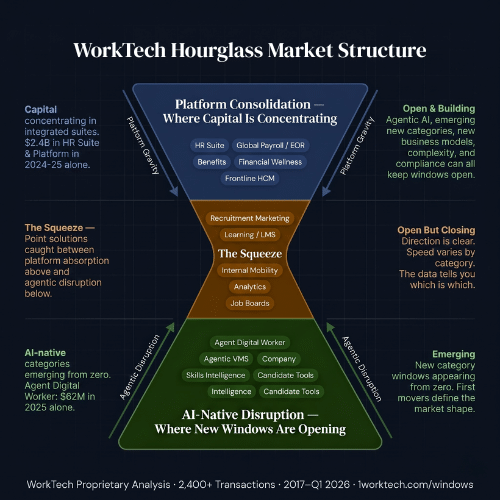
Understanding the Platform Gravity Belt is the key to reading every other window analysis in this series correctly. Every category that is closing fast is closing because of what is being built here. Every category that is open and building is open because it is operating at the edges of what the belt has not yet absorbed.
Other platform categories will be examined throughout this series: talent acquisition, learning, analytics, workforce management, and so on. Each has its own gravity and its own window. But we start here with Core HR, Payroll, Benefits, and Financial Wellness because this is where platform gravity was born. The performance of this cluster is unmatched in the dataset. The compliance complexity that drives adoption across every market segment and industry vertical makes it a must-have, not a nice-to-have. And the convergence happening inside it is reshaping what every other platform category has to compete with.
Core platform adoption in this cluster is not the question. It is the baseline. Every organization with employees has one or all of these solutions. The adoption question in the Platform Gravity Belt is about what comes next: the extended capabilities built on top of the compliance foundation, the AI introduced into workflows that have historically been entirely manual, and the financial services layer constructed on top of the payroll relationship. That is where adoption is still being won and lost. And that is what the capital flowing into this cluster is betting on.
This report covers the Platform Gravity Belt as a global category. The North American story is real and gets its full treatment here. But the belt looks completely different in APAC, Latin America, Africa, and the Middle East, where HR and workforce technology is not about replacing legacy software. It is about building the infrastructure that never existed. Europe has its own distinct chapter, shaped by fragmented employment law and a generation of local challengers building what global incumbents have struggled to replicate. The geographic dimension of this category is one of the most underreported investment stories in the WorkTech dataset. The Geographic Dimension Section covers it in full, and the market context it provides will shift how you read everything before it.
This is the founding category. And its gravity is pulling everything else in this series toward it or pushing it away from it. Knowing which is which starts here.
The only category cluster in the dataset where peak funding is 2025 and 2026, not 2021. The full five-dimension assessment is in the Window Scorecard below.
In This Report

The Window Scorecard
Funding Data: Accelerating
The belt is the only category cluster in the dataset where the peak funding year is not 2021. HR Suite and Platform peaked in 2025. Financial Wellness peaked in 2026. Total belt funding in 2024-25 was $6.5 billion, the highest two-year total in the cluster’s history. The direction of capital is unambiguous: the belt is not recovering from a contraction. It never contracted in the way the rest of the market did.
The nature of the deals is as important as the volume. The largest rounds are going to platforms with multiple integrated capabilities, not point solutions. These are platform bets, and the market is rewarding platform breadth with platform-scale capital.
Buyer Trends: Accelerating
The consolidation trend at the buyer level is as clear as the funding trend at the capital level. HR leaders across all segments are actively reducing the number of HR technology vendors in their stacks, and the belt platforms are the primary beneficiaries. The question buyers are asking is not “which payroll vendor should I use?” It is “which platform should anchor my entire HR stack?”
SMB buyer behavior is being shaped by the financial services convergence; the small business owner who added EWA as an employee benefit is now evaluating whether the EWA provider should become the payroll provider. The bundling logic driving SMB buyer decisions is pulling the financial services and HR layers together in ways that incumbent platforms are racing to capture.
Adoption Data: Stable to Accelerating
The belt is the category cluster where institutional AI adoption is most advanced. The compliance use cases for AI in payroll, benefits administration, and HR data management are well defined, the risk of error is quantifiable, and the ROI of automation is demonstrable. The adoption curve in the belt is ahead of the rest of the market.
Global payroll adoption is at an inflection point. The normalization of distributed and remote work has moved global payroll from a specialized capability to a mainstream requirement for a much larger segment of mid-market employers than it was five years ago.
M&A Activity: Accelerating
The M&A story in the belt is a consolidation story, unfolding through both acquisitions and organic platform expansion.
Workday’s acquisition spree is the most significant M&A signal in the enterprise tier. At least $2.1 billion in confirmed acquisitions in 2024-25: Paradox at $1.0 billion and Sana at $1.1 billion, with HiredScore, FlowiseAI, Evisort, and Pipedream at undisclosed prices. This is not a feature acquisition. It is architectural repositioning from a system of record to a platform of agents. Every standalone vendor in the categories Workday is absorbing- talent acquisition, learning, contract intelligence, and AI connectivity received a signal about their window when these deals were announced.
Paychex’s $4.1 billion acquisition of Paycor in April 2025 is the single largest M&A event in the mid-market HCM segment in recent memory. It reshapes the competitive landscape in the 200-2,000-employee tier and signals that mid-market consolidation is being driven by incumbents acquiring their way to broader capabilities.
ADP’s acquisition of Workforce Software in October 2024 extended its workforce management capabilities for large enterprises, a direct competitive response to UKG’s heritage strengths in time, attendance, and scheduling. Paylocity’s $325 million acquisition of Airbase expanded the platform into the CFO’s office, deepening the relationship beyond HR and significantly increasing switching costs.
Deel’s acquisition of Safeguard Global’s payroll division, serving over 140 markets and processing more than 2.4 million pay slips per year, was a direct statement that Deel intends to lead global payroll, not just EOR. The PEO market is consolidating at the regional level- PrestigePEO, G&A Partners, and others continuing the roll-up of regional compliance and service assets into larger, better-capitalized platforms. The adjacent market M&A signals: OneDigital acquiring MP Wired for HR, insurance and financial services firms acquiring payroll distribution capabilities, are the earliest indicators of the financial services convergence pulling outside industries into the belt. These deals will accelerate.
WorkTech Lens: Open & Building — The Widest Part of the Hourglass
The Platform Gravity Belt is the clearest Open & Building signal in the entire dataset, and it is the window that every other window in this series is being measured against.
The four signals converge on the same verdict. Capital is accelerating. Buyers are consolidating. Institutional AI adoption is ahead of the market. M&A is signaling platform-level exit multiples. The compliance foundation is generating new investment theses faster than the existing ones mature. The service layer is deepening the moat. The geographic expansion, particularly in emerging markets, is opening new windows inside a category that the North American analyst frame has already declared mature.
The Platform Gravity Belt is not mature. It is the market structure itself, the force that is pulling capital away from point solutions, absorbing categories into platforms, and creating the gravitational center that every other category in this series is either building toward or being pulled into.
Open & Building. The widest part of the top. And still building wider.

The Platform Story
The HCM platform race is not over. But the field has narrowed, and the competitive dynamics look completely different depending on where you are in the market.
WORKTECH · Opening & Closing Market Windows
The Platform Gravity Belt: Competitive Landscape
Enterprise through SMB — plus EOR and adjacent market entrants
| Enterprise Tier | Mid-Market Tier | SMB Tier | EOR + Adjacent |
|---|---|---|---|
| Workday | ADP Workforce Now | Gusto | Deel |
| SAP SuccessFactors | Paychex + Paycor | ADP Run | Remote |
| Oracle HCM | Dayforce | Paychex Flex | Papaya Global |
| UKG Pro | UKG Ready | Homebase | UKG One View |
| ADP (Enterprise) | Paycom | OnPay | Intuit (entering) |
| Paylocity | Factorial | OneDigital / MP | |
| isolved | SmartHR (Japan) | ||
| Vensure / Namely | |||
| HiBob | |||
| BambooHR |
WorkTech Proprietary Analysis · 2,400+ Transactions · 2017-Q1 2026 · 1worktech.com/windows
The Enterprise Tier: The Gravitational Constants
At the enterprise tier, three incumbents hold the majority of the installed base: Workday, SAP SuccessFactors, UKG, and Oracle HCM. These are not vendors under pressure. They are the platforms that every other vendor in this series is either building on top of, integrating with, or being absorbed by. Their roadmaps are the market structure.
Workday is the most aggressive acquirer in the belt, and the acquisition pattern tells a strategic story that is more important than any single deal. HiredScore (March 2024) brought AI-powered talent orchestration. Paradox (October 2025) brought conversational AI for high-volume and frontline hiring. Sana ($1.1 billion, 2025) brought AI-native learning and agent capabilities. FlowiseAI, Evisort, and Pipedream added AI infrastructure, contract intelligence, and agent connectivity. In total, Workday has spent at least $2.1 billion on confirmed acquisitions in 2024-25: Paradox at $1.0 billion and Sana at $1.1 billion, with additional acquisitions including HiredScore, FlowiseAI, Evisort, and Pipedream at undisclosed prices, while explicitly repositioning itself from a system of record to a platform of agents. The CEO of Paradox now leads Workday’s entire talent acquisition platform. The CEO of Sana now leads Workday’s entire learning platform. These are not integration announcements. They are architectural bets on what enterprise HR technology will become when AI is the interface rather than a feature.
SAP SuccessFactors runs more enterprise HR globally than any other system. I think the market forgets their scale. A position built over decades that is extraordinarily difficult to displace regardless of what challengers build. SAP’s AI investment across SuccessFactors is deepening the compliance and workflow infrastructure that enterprise buyers depend on, and its integration with the broader SAP ecosystem gives it a cross-functional data advantage that pure-play HCM vendors cannot replicate. SAP’s acquisition of SmartRecruiters and its investment in the Winston AI platform signal that SAP is not ceding the AI-native talent acquisition space to new entrants. Winston represents SAP’s architectural bet on conversational and agentic AI embedded directly in the SuccessFactors workflow, a bet that SAP’s enterprise installed base gives it the distribution advantage to win if the product delivers.
Oracle HCM is a substantial platform with a deep enterprise and upper-mid-market installed base, genuine capabilities across Core HR, Payroll, Talent, and Analytics, and a presence in virtually every enterprise RFP. But Oracle deserves a specific note, not because of what it is doing, but because of what it is not. Oracle has effectively settled into a database and infrastructure position, the relational backbone of large enterprise technology stacks, and its HCM investment has reflected that posture for the better part of a decade. The ecosystem is deep but increasingly closed. The roadmap is real but rarely leads the market conversation. The customer base is loyal in the way that large enterprise customers are loyal to anything deeply embedded in their infrastructure — not enthusiastically, but durably. Oracle is not losing the enterprise HCM market. But it is not competing for it the way Workday, SAP, and UKG are. For buyers evaluating Oracle HCM today, the right question is not whether Oracle can do what you need. It is whether Oracle intends to lead the category in AI, in financial services integration, or on the compliance frontier, or to remain the database underneath the platforms that do. That is a strategic question that Oracle’s recent market behavior has not answered clearly. And in a market moving as fast as this one, the absence of a clear answer is itself an answer.
UKG Pro is the fourth enterprise-tier platform with particular strength in industries where workforce complexity is highest: healthcare, retail, manufacturing, and hospitality. UKG’s heritage in time and attendance, scheduling, and workforce management gives it a compliance and operational depth in these verticals that the pure HR Suite vendors have historically struggled to match at scale. UKG’s global payroll story is separated from its platform story, and significantly underappreciated. The acquisition of Immedis, now UKG One View, gave UKG something that most HCM platforms are still trying to build: a truly global payroll capability with on-the-ground expertise, local compliance infrastructure, and a genuine integrate-anywhere architecture that enterprise multinationals require. This is not a “we support 40 countries” marketing claim. It is operational infrastructure built on local expertise, local data, and local service resources in markets where payroll compliance is not a software problem, it is a people and process problem that software enables. The expansion of One View capabilities into UKG Ready, with more planned, means UKG is building a global payroll story that spans both the enterprise and mid-market tiers. A combination that Deel and Remote are building toward from the EOR side but that UKG has been building from the compliance and service side for years.
The Mid-Market: The Most Contested Battlefield
The mid-market is where the most consequential competitive battle in the belt is playing out, and it has been underway for longer than the funding data suggests. ADP, Paychex, and Dayforce built their mid-market positions over decades, and they remain the dominant revenue players in this tier by a significant margin. Their installed bases are enormous, their compliance infrastructure is deep, and their switching costs are real. They are not losing this market. But they are being challenged in ways they have not faced before.
The most significant mid-market M&A event in recent memory reshaped the competitive landscape in April 2025: Paychex completed its $4.1 billion acquisition of Paycor, creating a combined entity serving over 790,000 clients. Paycor brought approximately 49,000 clients and a modern, mid-market-focused HCM platform with strong talent management tools, giving Paychex a significantly stronger position in the upper mid-market where Paycor had built its reputation. This is not a defensive move. It is a consolidation play that signals Paychex’s intent to compete at every tier of the mid-market with a more complete product and a larger customer base.
Paycom and Paylocity represent the previous generation of mid-market challengers. These are payroll-native platforms that have built outward into Core HR, Time, and Talent over the past decade and have taken meaningful share from ADP and Paychex in the 500-5,000-employee segment. Both are publicly traded, profitable, and deeply embedded in their customer bases. Paylocity’s 2024 acquisition of Airbase ($325 million) added a full finance and spend management suite, expanding the platform beyond HCM and into the CFO’s office. That is a deliberate strategic move to deepen the platform relationship beyond HR and further increase switching costs. Paylocity has also partnered with Vestwell for 401(k) administration and Blue Marble for global payroll, an ecosystem approach to capability expansion that complements rather than replaces organic development.
Dayforce has built its service layer around the complexity of large, distributed workforces. The retail chains, healthcare systems, and manufacturing operations that are its core customer base. Dayforce’s workforce management depth gives it a compliance advantage over pure HR Suite vendors for variable-hour, shift-based, and multi-location workforces that the pure HR Suite vendors have not fully replicated.
UKG Ready is the most underappreciated growth story in the mid-market segment. Built for organizations below the UKG Pro ceiling, Ready has demonstrated consistent momentum over the past several years as UKG has invested in the product and expanded its capabilities. The platform’s recent AI introduction, delivered with meaningful spend controls and no usage-cost creep, is a notable differentiator in a market where AI pricing anxiety is real, and buyers are watching their total cost of ownership carefully. Ready’s current employee count ceiling is arguably the single biggest constraint on a product that could compete effectively across a much wider segment than it currently serves. If UKG increases that ceiling, Ready becomes a significantly more disruptive force in mid-market HCM than most competitive analyses currently account for. That is not a funding story. It’s a product and strategy story, and it is one of the clearest examples in this series of the operator lens that data alone cannot provide.
isolved is also underappreciated as a platform in the mid-market dataset. Investors put $350 million in 2025 at a company that has been building a PEO and HCM integrated stack for years with a customer base that other vendors in this category would pay significantly to access. Vensure Employer Solutions raised $450 million in 2026, the largest single deal in the dataset, and operates the Namely platform as part of a broader HRIS, PEO, and HR services infrastructure that serves companies that want technology and services together, not technology alone.
HiBob has built a genuinely differentiated position in the mid-market by focusing on the modern, people-first HR experience that legacy mid-market platforms were not designed to deliver. Its traction in Europe and among tech-forward mid-market companies is real, and it represents a different kind of platform thesis than the payroll-anchored model. HiBob started with the employee experience layer and built payroll and compliance outward. HiBob has built a genuinely differentiated position in the mid-market by focusing on the modern, people-first HR experience that legacy mid-market platforms were not designed to deliver. Its traction in Europe and among tech-forward mid-market companies is real, and it represents a different kind of platform thesis than the payroll-anchored model. HiBob started with the employee experience layer and built payroll and compliance outward. In the US market, however, the absence of payroll at scale has been a meaningful constraint. The decision to delay a serious US payroll investment until recently may prove to be a timing problem. The windows in this market are moving faster than most platform roadmaps anticipated, and the larger platforms are not waiting. Every month that passes without a credible US payroll story is a month where the consolidation logic favors a competitor with a complete stack.
BambooHR deserves a specific mention as one of the most quietly effective platform builders in the mid-market. While the funded challengers generated headlines, BambooHR has been methodically extending its platform, adding payroll, benefits administration, hiring, and performance management to what began as a clean HRIS for small and mid-sized businesses. It does not appear prominently in funding data because it has not needed to raise at the pace of its competitors. What it has built instead is a deeply loyal customer base, a reputation for exceptional implementation and support, and a platform that now covers the full HR stack for its target segment. In a market full of vendors chasing the next funding round, BambooHR is an execution story, and execution at that consistency level is its own competitive moat.
The SMB Tier: The Consolidation Race
At the SMB tier, Gusto is the most important platform story that funding data alone cannot capture. Gusto has built a deeply embedded payroll and HR platform for small businesses with a customer base and a Net Promoter Score that the venture-backed challengers have consistently struggled to match. It is the incumbent in the SMB segment, and its expansion into benefits, time tracking, and financial services for small business employees is the clearest example of the payroll convergence thesis playing out at the bottom of the market.
ADP‘s SMB presence deserves equal recognition. ADP Run and ADP’s small business payroll and HR products serve more small businesses than any other provider in North America by volume. The brand trust, compliance depth, and distribution reach that ADP has built over decades in the SMB segment are assets no venture-backed challenger has come close to replicating. The difference between ADP and Gusto in the SMB market is not capability. It is experience design and relationship model. Gusto wins on modern experience and high-touch onboarding. ADP wins on compliance confidence, brand recognition, and the accountant-and-bookkeeper channel, which refers more SMB payroll business than any other distribution channel in the market. Both are winning. They are winning different buyers.
Homebase raised $60 million in 2024 to target the hourly and frontline workforce, a segment that generic SMB platforms were not built for and that enterprise incumbents have largely ignored. The scheduling, time tracking, and payroll complexity of managing shift-based workers at small businesses are compliance and workflow problems that generic HR platforms solve poorly.
OnPay raised $100 million in 2025, in equity and debt combined, a payroll-native platform expanding into the full HR Suite thesis from the bottom up. Factorial raised $200 million across 2024 and 2025, cementing its position as the European SMB challenger with traction in Spain, France, and Latin America. SmartHR raised $236 million across 2024 and 2025, operating primarily in the Japanese market where HR digitization is years behind the US and Europe, and where the compliance complexity of Japanese labor law creates a moat that global platforms have not been able to clear.
The EOR Players: A New Competitive Dimension
The EOR players have added a competitive dimension to the platform landscape that did not exist five years ago. Deel, Remote, and Papaya Global built their initial positions on the regulatory arbitrage of global employment, helping companies hire internationally without establishing legal entities. But none of them is an EOR company anymore.
Deel raised $300 million in 2025 and is building a full HR Suite that competes directly with mid-market HCM platforms for companies with distributed global workforces. Its acquisition of Safeguard Global’s payroll division, a provider serving over 140 markets and processing more than 2.4 million pay slips per year, was a direct statement of intent to lead the global payroll market, not just the EOR market. The EOR wedge opened the door to the platform market, which is now wide open.
Remote has followed a similar trajectory, expanding well beyond its EOR origins into a full global HR platform with payroll, benefits, and workforce management capabilities across 180+ countries. Its $59 million raised in 2024 reflected continued investor conviction in the global employment infrastructure thesis as Remote deepened its platform and compliance coverage.
Papaya Global took a different approach, building the global payroll infrastructure and workforce payments layer that sits underneath the EOR model, targeting enterprises that need compliant payroll execution across multiple countries without the full EOR wrapper. It is infrastructure rather than service, a distinction that matters for how these businesses are valued and how they compete.
The Adjacent Market Signal
Perhaps the most significant signal of where platform gravity is pulling came entirely from outside the traditional HCM competitive set. Intuit’s announcement of its intent to enter HCM is not a product story. It is a gravitational story. Intuit owns the financial layer of millions of small businesses through QuickBooks and TurboTax: the accounting, the taxes, the cash flow. Adding HR and payroll is not a stretch. It is the logical next step for a platform that already holds the employer’s financial relationship. When a market-leading brand from an adjacent category decides your market is worth entering, it is one of the clearest signals that the window is wide open and that the competitive dynamics are about to change.
OneDigital’s April 2026 acquisition of MP Wired for HR tells the same story from a different angle. OneDigital is a leading insurance brokerage and financial services firm, not an HR technology company. Its acquisition of an HCM and payroll platform reflects the financial services industry’s recognition that the payroll relationship is a financial services distribution channel worth owning. The convergence of HR tech and financial services is not just happening inside the belt. It is pulling adjacent industries into the belt from outside.
*Employee Engagement and Generic TM/PM/Comp 2024-25 figures reflect AI-native repositioning plays, not standalone point solutions.
** Traditional Job Boards 2024-25 figure reflects evolved marketplace model, not pure transactional job ad model.
The Payroll Convergence
The convergence thesis is straightforward: payroll is no longer just payroll. It is becoming the financial and operational infrastructure layer of the workforce, absorbing earned wage access, financial wellness, retirement savings, global employment compliance, and embedded banking into what was once a back-office transaction function. The category label is dissolving. What is replacing it doesn’t yet have a clean name. But the capital flowing into this space, the product trajectories of the platforms building here, and the regulatory frameworks laid down in 2024 and 2025 are all pointing in the same direction. This section maps the four dimensions of that convergence and what it means for every player in the belt.
Four completely different investment theses are operating inside what looks like one category cluster.

The Segment Lens
Before examining the convergence, the segment context matters, because payroll looks completely different depending on where you sit in the market.
At the enterprise tier, payroll is not primarily a standalone purchasing decision. It is a module within a platform decision made years ago. Workday Payroll, SAP Payroll, Oracle Payroll, and ADP are not competing for new logos in isolation; they are the payroll layer of a broader HCM or services commitment that enterprise buyers have already made. The switching cost is not just the payroll system. It is the entire integrated stack. This creates profound stickiness at the enterprise tier, insulating incumbents from much of the convergence pressure playing out below them, at least in the short term. UKG‘s continuous, real-time payroll and workforce management software, unifying gross-to-net calculations, timekeeping, and tax compliance into a single engine rather than as adjacent modules, is a meaningful architectural differentiator in the verticals where workforce complexity is highest. The enterprise payroll story is less about competitive displacement and more about expansion: more geographies, more workforce types, deeper compliance automation, and an AI layer built atop existing infrastructure.
In the mid-market tier, the payroll competitive landscape is the most crowded and dynamic across the entire belt. ADP, Paychex (now including Paycor), Paycom, Paylocity, Dayforce, UKG Ready, and isolved are all competing for largely the same buyer: the HR leader at a company with between 100 and 2,000 employees who need payroll, benefits, time, and compliance in an integrated platform. The convergence of payroll with financial services, global workforce infrastructure, and embedded banking is creating new competitive pressure from vendors that the mid-market incumbents were not designed to compete against. BambooHR, while not a payroll-first platform, has been quietly building payroll and benefits capabilities into its mid-market HRIS. It is an execution-driven approach to convergence that mirrors the organic build strategy rather than the acquisition or funding route.
At the SMB tier, payroll is the anchor product around which the full HR stack is being built. The market reality is that three providers: Intuit QuickBooks, ADP Run, and Paychex Flex collectively serve nearly 46% of all SMB employers nationwide. That concentration is not an accident. It reflects decades of distribution through accountants, bookkeepers, and financial advisors who recommend payroll solutions to small business owners at the moment of greatest need, when they hire their first employee. The compliance confidence, the brand recognition, and the trusted advisor channel that these three incumbents have built are structural advantages that product features alone cannot overcome.
The challenger story at the SMB tier is real, but it operates in the context of that concentration. Gusto has built the most credible challenger position, a deeply embedded payroll and HR platform with a customer base and Net Promoter Score that the venture-backed competitors have consistently struggled to match, and its expansion into benefits, time tracking, and financial services for small business employees is the clearest example of the convergence thesis playing out at the bottom of the market.
OnPay raised $100 million in 2025. A payroll-native platform expanding into the full HR Suite from the bottom up, competing directly in the overlap between incumbent and challenger. Homebase is building into a different SMB problem entirely: the hourly and shift-based workforce, where scheduling, time tracking, and payroll compliance for variable-hour workers create complexity that the generic SMB platforms solve poorly.
Intuit‘s announced intent to enter HCM more fully signals that the financial services convergence thesis is pulling the largest SMB financial platform directly into the HR stack. A move that could reshape the SMB competitive landscape more significantly than any of the venture-backed challengers.
These are not all competing for the same buyer. They are covering different problems within the same tier, and the convergence thesis is pulling all of them toward the same destination from different starting points.
Something Is Happening to Payroll That the Category Label No Longer Captures
Payroll used to be a back-office function. A compliance requirement. A cost center that processed transactions on a schedule and produced a report. That definition is dissolving. And the $8.2 billion in payroll-related funding over eight years, with $2.1 billion in 2024-25 alone, is the financial signature of a category in the middle of a fundamental identity transformation.
The convergence has four dimensions.
Payroll as Financial Services Distribution
WORKTECH · Opening & Closing Market Windows · The Payroll Convergence
Payroll as Financial Services Distribution
The payroll relationship is becoming the distribution infrastructure for a much broader financial services product set
Embedded Banking + Banking-as-a-Service
Unbanked and underbanked workforce — emerging markets focus
Retirement + Savings Infrastructure
Compliance-driven adoption — auto-enrollment, student loan matching
Financial Wellness + Employee Loans
Employment verification as underwriting signal
Earned Wage Access
The compliance wedge — financial services companies distributing through payroll
The Payroll Relationship
Highest switching cost in the HR stack. Weekly engagement rhythm. Compliance obligation that cannot be deferred.
ADP · Paychex · Gusto · Workday · UKG · Dayforce · isolved · Deel
Combined 2024-25 investment across these layers: $2.1B+
The payroll relationship is not the product. It is the distribution channel.
WorkTech Proprietary Analysis · 2,400+ Transactions · 2017-Q1 2026 · 1worktech.com/windows
The most significant shift in the payroll category is not a technology change. It is a business model change. Payroll has become the most trusted, most frequent touchpoint between an employer and an employee. And that relationship is being monetized as a financial services distribution channel.
Earned Wage Access is the wedge. Rain ($300 million of investment in 2024, $75 million in 2025), DailyPay ($175 million of investment in 2024), Tapcheck ($225 million of investment in 2025), Wagestream ($396 million of invesmtne in 2025. The largest single EWA round in the dataset), Earnin ($150 million and $75 million of investment in 2025), and Clair ($23 million of investment in 2025) are not payroll companies. They are financial services companies that distribute through the payroll relationship. The compliance infrastructure required to deliver earned wages in compliance with state-specific wage payment laws, CFPB guidance, and emerging EWA regulations is what makes this a technology business rather than a lending business.
The expansion beyond EWA is already underway. Kashable ($250 million, $37 million, and $26 million of investment across 2024-25) is delivering employee loans through the payroll relationship. Purchasing Power ($218 million fo investment in 2024) is delivering employee purchasing programs through payroll. Vestwell ($385 million fo investment in 2026) is building retirement savings infrastructure that sits on top of the payroll relationship. The common thread is the payroll relationship as the distribution infrastructure for a much broader financial services product set.
Payroll as Compliance Infrastructure
Every major investment thesis in the payroll convergence traces back to a regulatory event. EWA exists because state wage payment laws created a compliance framework that required a technology layer to manage. Global payroll exists because employment law across 100+ jurisdictions requires infrastructure that no single employer can build internally. Vertical payroll exists because healthcare compliance, construction prevailing wage, entertainment union rules, and gig economy classification requirements create compliance complexity that generic payroll rails cannot handle.
CloudPay ($120 million of investment in 2024) is building enterprise global payroll compliance infrastructure. Miter ($23 millionof investment in 2025) is building payroll compliance infrastructure for construction: prevailing wage, certified payroll reporting, and union rules. Wrapbook ($20 million of investment in 2024) does the same for entertainment and production. The compliance lens is essential here because it explains why the convergence is not just a technology story.
Payroll as Global Workforce Infrastructure
Deel, Remote, Oyster, and Papaya Global did not build EOR and global payroll businesses because global employment was a convenient market. They built them because the compliance complexity of employing workers across 100+ jurisdictions created a moat that generic payroll platforms could not clear.
Borderless AI ($27 million of investment in 2024) is an AI-native EOR entrant, building the global employment compliance infrastructure with an AI-first architecture. Remofirst ($25 million of investment in 2024) and Native Teams ($7 million of investment in 2024) are building into the contractor and freelancer layer of global workforce payments. WorkPay ($9 million of investment), Cadana ($7 million), dopay ($14 million), Abhi ($15 million), TudoNoBolso ($2 million) are building global payroll infrastructure for emerging markets where the thesis is financial inclusion and workforce formalization, not distributed work for US or European companies.
Payroll as the Anchor of the Integrated Stack
Underneath all three dimensions of the convergence is a structural reality that every platform player already understands: payroll is the stickiest product in the HR stack. The switching cost of changing payroll platforms is higher than any other HR technology decision. The compliance risk of a payroll error is existential. And the frequency of payroll processing creates an engagement rhythm with the platform that no other HR product can match.
This is why every durable platform in the belt, from ADP to Gusto to Darwinbox to Deel, first anchored in payroll and then expanded outward. The companies that own payroll own the relationship. And the convergence of payroll with financial services, compliance infrastructure, and global workforce management is not merely a category-adjacency story. It is a platform gravity story.
The category label ‘payroll’ no longer captures what is being built here. The market has not yet settled on a new name. But the funding data, the product trajectories, and the compliance infrastructure being laid down in 2024 and 2025 are pointing clearly in one direction: payroll is becoming the financial and operational infrastructure layer of the workforce. That is a much larger market than payroll has ever been.
The Compliance Foundation
Compliance did not constrain this category. It created it.
Every major software category in the Platform Gravity Belt exists because a regulatory event made manual processes legally untenable. ERISA created benefits administration software. FLSA created payroll software. The ACA created benefits platform complexity that drove the current generation of benefits technology investment. SOX created the audit trail requirements that made HR data management a board-level concern. The software exists because the regulatory requirement exists, and the regulatory requirement does not go away.
This is the fundamental difference between the Platform Gravity Belt and every other category in this series. A standalone point solution in any category can be absorbed by a platform because the use case is not legally mandated. But payroll cannot be deprioritized. Benefits administration cannot be skipped. Core HR compliance documentation cannot be deferred. The must-have nature of this category cluster is not driven by buyer preference or technology trend. It is driven by legal obligation, and legal obligations do not follow the funding cycle.
The Compliance Drivers Creating the Next Wave
Pay transparency legislation is the most immediately impactful. Colorado, California, New York, Illinois, and a growing list of states now require salary range disclosure. The EU Pay Transparency Directive creates similar requirements across European markets. This regulatory shift is generating demand for compensation intelligence, pay equity analytics, and total rewards platforms that will be covered in a dedicated report later in this series.
SECURE 2.0 is quietly generating one of the most significant investment theses in the benefits layer. The legislation expanded access to retirement savings plans for part-time workers, created new auto-enrollment requirements, and introduced student loan matching as a benefits option. Each of these creates a technology requirement. Human Interest ($267 million of funding in 2024), building retirement infrastructure for SMB employers, is a compliance-driven investment thesis executing against a regulatory mandate.
Global employment compliance is the most complex frontier. The proliferation of remote and distributed work has created an enforcement gap between where work is performed and where it is legally structured, and regulators in the EU, UK, and increasingly in APAC and Latin America are closing that gap. Worker classification rules, permanent establishment risk, local benefits mandates, and data residency requirements are all generating compliance obligations that neither employers nor the legacy HCM platforms were built to manage at scale.
AI compliance is the emerging frontier that will shape the next generation of HCM platform investment. The EU AI Act creates specific requirements for AI systems used in employment decisions. Several US states are moving toward similar requirements. The HCM platforms that have already built audit trails, explainability layers, and bias detection into their AI modules will have a compliance moat that late movers cannot quickly replicate. Workday’s acquisition of HiredScore was explicitly framed around responsible AI in talent decisions, a compliance positioning as much as a technology one.
Worker classification and the gig economy compliance frontier is generating investment across multiple categories simultaneously. The ongoing legislative battles over independent contractor classification: AB5 in California and the EU Platform Work Directive, are creating compliance requirements for workforce management, payroll, and benefits that platform companies, staffing firms, and gig economy operators are all trying to solve.
Compliance as Competitive Moat
The compliance foundation does more than drive must-have adoption. It creates the most defensible competitive moats in the entire Work Tech market.
A platform that has built deep compliance infrastructure in a specific vertical or geography has an asset that cannot be quickly replicated. UKG’s depth in healthcare, retail, and manufacturing compliance. UKG Pay Now’s on-the-ground expertise in global payroll compliance. Miter’s construction payroll compliance rails. Wrapbook’s entertainment industry union compliance. SmartHR’s Japanese labor law infrastructure. Darwinbox’s compliance architecture for Indian and Southeast Asian employment law. These are not feature advantages. They are moats built from years of regulatory expertise, local relationships, and the operational infrastructure required to execute compliance correctly at scale.
The implication for every other category in this series is direct. When you see a category where compliance complexity is high: contingent workforce management, benefits administration, global payroll, workforce management for regulated industries, the market window assessment changes. The timeline extends. The moat deepens. And the vendors who have built their compliance infrastructure over years rather than months have a durable advantage that the funding data alone cannot fully capture.
Compliance did not constrain this category. It created it. And it is creating the next ones.
Service as Software: The Moat That Data Cannot Measure
The Platform Gravity Belt is not a pure software story. It never was.
But the service dimension of this category is more relevant right now than it has been in years, and for a reason that shows up in almost every CHRO conversation happening in 2025 and 2026. HR leaders are caught between two forces that are pulling in opposite directions simultaneously. The ELT is pushing for AI adoption, cost reduction, and workforce transformation at a pace that the HR function has never been asked to move at before. Legal and compliance are pulling back, flagging risks, requiring reviews, slowing implementation, and, in some cases, blocking deployments entirely until governance frameworks catch up with the technology. The CHRO sitting between those two forces needs more than software. They need expertise, accountability, and a service relationship capable of navigating the organizational and regulatory complexity that software alone cannot resolve.
This is the environment in which the service layer of the Platform Gravity Belt has become a strategic differentiator rather than a legacy overhead. The platforms that can deliver compliance confidence alongside technology capability, bringing what was traditionally seen as separate offerings into an integrated experience, are the ones winning renewals and new business in the current market. The ones that sell software and expect buyers to figure out compliance and organizational complexity, and to order their support from the services menu on their own, are losing.
From the earliest days of payroll bureaus to the modern PEO and EOR models, the companies that built durable positions in this category group did so by combining technology with service, and then using technology to make that service more scalable, more consistent, and more defensible. The software is the delivery mechanism. The service is the value proposition. And right now, in the market as it exists today, that value proposition has never been more relevant.
The Service Layer Was Born Out of Necessity
The buyers of HR technology, particularly in the SMB and mid-market, have always faced the same fundamental constraint: they lack sufficient internal HR expertise to fully leverage the software’s capabilities. A 200-person company typically has one or two HR professionals managing compliance, payroll, benefits, onboarding, and employee relations simultaneously. We can also add recruiting on the list, for those with lower growth rates. They bought software that came with people because people were the difference between the software working and sitting unused.
This is the origin story of the PEO model. ADP TotalSource, Paychex PEO, isolved, Vensure Employer Solutions, TriNet, and dozens of regional PEOs built businesses on the fundamental insight that SMB employers do not just need payroll technology; they need someone to run payroll for them, answer the compliance question at 4 p.m. on a Friday, and manage the benefits renewal. The software is the infrastructure. The service is the reason they stay.
Who Is Doing It and How
WORKTECH · Opening & Closing Market Windows · Service as Software
Service as Software: Who Delivers What
The service layer is the moat that funding data cannot measure
| Provider | HR Advisory | Managed Payroll | Compliance Monitoring | PEO / Co-Employment | Global Service | Vertical Expertise |
|---|---|---|---|---|---|---|
| Paychex | ||||||
| ADP | ||||||
| UKG | ||||||
| Dayforce | ||||||
| isolved | ||||||
| Vensure | ||||||
| Gusto | ||||||
| Workday | ||||||
| Deel | ||||||
| Paycom | ||||||
| Paylocity |
WorkTech Proprietary Analysis · 2,400+ Transactions · 2017-Q1 2026 · 1worktech.com/windows
Paychex has built perhaps the most complete service ecosystem in the SMB and mid-market belt. Paychex HR Services provides outsourced HR support across the full spectrum, from HR generalist support to dedicated HR business partner assignments for mid-market clients. Paychex PEO delivers the co-employment model with compliance expertise, benefits administration, and risk management as core service components. The Paychex retirement services team manages 401 (k) plan administration and compliance for tens of thousands of small-business clients. And Paychex’s compliance monitoring service tracks regulatory changes at the federal, state, and local level, proactively communicating implications to clients.
The breadth of the Paychex service ecosystem is one of the primary reasons its client retention rates are among the highest in the mid-market segment. The Paycor acquisition adds modern talent management depth to that service ecosystem, a combination that makes the post-merger Paychex a more complete service and technology provider than either company was independently.
UKG has built one of the most comprehensive service layers in the mid-market and enterprise segments. UKG’s HR Advisory Services provides on-demand HR expertise: compliance guidance, policy development, employee relations support that functions as an extension of the client’s internal HR team. UKG’s implementation and managed services organization is among the deepest in the industry. And UKG One View adds a global service layer that is genuinely differentiated: on-the-ground expertise in local payroll compliance that is operational, not just advisory.
ADP has built the largest service organization in the belt by volume. ADP TotalSource is one of the largest PEOs in the United States. ADP’s compliance services organization monitors regulatory changes across all 50 states and communicates updates to clients, particularly valuable for multi-state employers. ADP’s HR HelpDesk provides on-demand HR advisory support. At the enterprise tier, ADP’s managed payroll services handle the full payroll operation for large employers who want to outsource execution, not just the technology.
Dayforce has built its service layer around the complexity of large, distributed workforces. Its managed services offering handles payroll processing, time and attendance administration, and compliance reporting. The Dayforce HR consulting practice provides workforce strategy and compliance advisory services, particularly valuable for clients navigating the intersection of scheduling complexity, wage-and-hour compliance, and labor relations.
isolved has built a service model particularly well suited to the SMB and lower mid-market, combining the PEO co-employment option with a direct HCM platform option and a network of HR service providers who deliver advisory services through the isolved platform. This network model — where third-party HR consultants and brokers deliver services on top of the technology — creates a service ecosystem that extends beyond what isolved can deliver internally.
Vensure Employer Solutions has built one of the most comprehensive PEO service models in the market, providing not just co-employment and compliance services but a full suite of HR outsourcing capabilities including benefits administration, payroll processing, risk management, and HR consulting. The Namely platform acquisition gave Vensure a mid-market HCM technology capability to pair with its service depth, as well as a growth path for clients sizing out of the PEO model.
Gusto has taken a different approach to the service layer, building self-service compliance guidance, automated regulatory updates, and proactive notifications into the product itself. Gusto’s licensed financial/benefits advisors and certified HR professionals are embedded in the platform, available for benefits and insurance questions, retirement/401(k) fiduciary access, and general HR compliance and process questions, represent an emerging form of service that blurs the line between software and advisory services.
Workday‘s implementation partner ecosystem of certified consulting firms, system integrators, and regional specialists is one of the largest professional services networks built around any HCM platform. For enterprise buyers, a Workday commitment is as much a decision about which implementation partner they will work with as it is about the software itself. The quality of that ecosystem varies significantly and navigating it is one of the less-discussed but more consequential decisions in an enterprise HCM deployment.
BambooHR has built its service model around implementation quality and customer success depth, a reputation for getting clients live and keeping them there that is a meaningful differentiator at the SMB and lower mid-market tier.
Deel has built a global service layer that is fundamentally different from the domestic compliance service models. Deel’s in-house legal and compliance team manages employment law across 100+ countries, not through partnerships or third-party advisors but through dedicated internal expertise in each market. Remote and Papaya Global have built comparable service models. The EOR players have also built immigration and visa support services, which are increasingly strategic as talent mobility becomes a competitive advantage and immigration complexity becomes a compliance obligation.
Paycom and Paylocity have built their service models around dedicated service representatives assigned to each client account. A deliberate retention strategy that creates relationship continuity that a software migration would cost the client. But both offer more than account management. Paycom’s Ask Here tool and HR advisory support give clients on-demand access to compliance guidance and HR best-practice recommendations embedded directly in the platform. Paylocity’s HR advisory services and its compliance and regulatory update communications provide a similar layer, proactive guidance on regulatory changes, policy implications, and HR practice that positions both companies as more than payroll processors. Neither has built the deep compliance consulting or outsourced HR delivery model that Paychex or ADP have, but both have moved meaningfully beyond pure software delivery toward an advisory relationship that raises the switching cost beyond the technology itself.
The regional and vertical specialists in the belt, Miter in construction, Wrapbook in entertainment, Clair in frontline and hourly, have built service layers that are entirely compliance driven. These are not generic HR compliance services. They are deep vertical expertise that the platform delivers as part of the product.
OneDigital’s acquisition of MP Wired for HR is a signal worth noting here. OneDigital is an insurance brokerage and financial services firm, not an HR technology company. Its acquisition of a payroll and HCM platform reflects the broader recognition that the service relationship an insurance broker or financial advisor has with an employer is the same relationship that HR technology vendors are trying to build. The convergence of HR tech and financial services is pulling adjacent service industries into the belt.
Why This Matters for the Window Assessment
The service layer fundamentally changes the window analysis in the Platform Gravity Belt. Pure software companies can be disrupted by better software. Service companies embedded in their clients’ operations, handling their compliance, running their payroll, managing their benefits, employing their global workforce, are disrupted by something much harder to build: trust, expertise, and operational presence built over years of showing up when it mattered.
The AI wave is not eliminating the service layer in the belt. It is transforming it. The platforms winning the service-as-software race are not the ones eliminating the human layer. They are the ones using AI to make their human layer more expert, more responsive, and more scalable, while deepening the compliance and operational moat that makes it impossible to replace them with software alone.
Service did not make this category defensible despite the technology. It made this category defensible because of it.
The Geographic Dimension
The Platform Gravity Belt is a global story told in four completely different chapters. The funding data makes this clear, but the category labels obscure it. ‘HR Suite/Platform’ means something fundamentally different in San Francisco than it does in Lagos, Jakarta, or São Paulo. The compliance requirements are different. The infrastructure assumptions are different. The workforce demographics are different. And the competitive landscape varies by chapter.
WORKTECH · Opening & Closing Market Windows · The Geographic Dimension
Four Chapters. One Belt.
The Platform Gravity Belt looks completely different depending on where you sit in the market
| 🌎 North America | 🌍 Europe | 🌏 APAC | 🌍 Global South + LATAM |
|---|---|---|---|
| The Consolidation Chapter | The Regional Challenger Chapter | The Infrastructure Building Chapter | The Financial Inclusion Chapter |
Key Dynamic SMB consolidation race. 46% of SMB employers with just three providers. Mid-market battle most contested. | Key Dynamic Fragmented employment law creates local compliance moats. Regional challengers outbuilding global incumbents on compliance depth. | Key Dynamic HR digitization still early. Local compliance complexity creates moats global platforms cannot clear quickly. | Key Dynamic Payroll digitization is not about replacing software. It is about replacing cash. Mobile-first financial inclusion infrastructure. |
Key Providers ADP Paychex + Paycor Gusto UKG Ready Dayforce Paycom Paylocity isolved Homebase OnPay | Key Providers Factorial Personio HiBob Deel Remote Papaya Global | Key Providers Darwinbox SmartHR BrioHR Omni HR SeamlessHR | Key Providers Buk WorkPay Cadana dopay Abhi NOW Money TudoNoBolso |
Compliance Driver Pay transparency laws. SECURE 2.0. State EWA regulations. AI governance emerging. | Compliance Driver EU Pay Transparency Directive. GDPR. EU AI Act. Platform Work Directive. | Compliance Driver Local labor law complexity. Japanese working hour rules. Indian labor codes. SEA fragmentation. | Compliance Driver Mobile money regulation. Digital wage payment rules. Labor formalization mandates. Wage Protection Systems. |
Window Signal EWA and financial wellness convergence most advanced. Intuit HCM entry reshaping SMB competitive dynamics. | Window Signal Pay Transparency Directive implementation by 2026 creating demand for compensation intelligence platforms. | Window Signal Local platforms building compliance moats years before global platforms arrive. First mover advantage is real. | Window Signal 600M+ African workers. 1B+ South Asian workers. Addressable market larger than all of North America and Europe combined. |
Four chapters. One belt. The gravity operates differently in each — but it operates everywhere.
The geographic dimension is one of the most underreported investment stories in the WorkTech dataset.
WorkTech Proprietary Analysis · 2,400+ Transactions · 2017-Q1 2026 · 1worktech.com/windows
North America: The Consolidation Chapter
The North American market is the most mature, the most competitive, and the most capital-intensive chapter in the belt. The SMB consolidation thesis is the primary investment story right now. Gusto, OnPay, Homebase, isolved, and the Paychex and ADP SMB products are all competing for the same buyer. The winner is not determined by feature parity. It is determined by ease of use, compliance confidence, and the service relationship that makes the buyer feel supported rather than abandoned.
The mid-market consolidation story is equally contested. ADP, Paychex (now including Paycor), Dayforce, UKG Ready, Paycom, Paylocity, isolved, BambooHR, and HiBob are all competing for the 200-2,000 employee segment. The AI capabilities being introduced in this tier, particularly UKG Ready’s AI with spend controls and no usage cost creep, are changing the competitive dynamic. The mid-market buyer is not asking “does your platform have AI?” anymore. They are asking “can I control how AI is used, what it costs, what it spends on my behalf, and what decisions it influences?” That is a question of compliance, governance, and financial accountability as much as it is a technology question.
The EWA and financial wellness convergence is most advanced in North America, driven by state-level wage payment regulations, the proliferation of gig and hourly workers, and the financial fragility of the American workforce. Pay transparency legislation is the most immediately impactful compliance driver, generating demand for compensation intelligence and pay equity analytics that will be covered in a dedicated report later in this series.
Europe: The Regional Challenger Chapter
The European market is defined by two forces operating simultaneously: the fragmentation of employment law across member states that makes local expertise a genuine competitive moat, and the emergence of a generation of regional HCM challengers building platforms specifically designed for the European compliance environment.
Factorial has built its position in Spain, France, and, increasingly, across Southern Europe and Latin America by tailoring to local compliance realities. Personio has built the equivalent position in the DACH markets, Germany, Austria, Switzerland, where works council consultation requirements, GDPR data protection obligations, and the complexity of German employment law create a moat that global platforms have consistently struggled to clear. HiBob has built a pan-European position by focusing on the modern employee experience, appealing to tech-forward mid-market companies across the UK, Netherlands, and Northern Europe.
The EU Pay Transparency Directive is the most significant driver of compliance in the European market over the next three years. Member states must implement the directive by 2026, requiring salary range transparency, pay equity reporting, and joint pay assessments for large employers. GDPR continues to shape HR data management in Europe, creating genuine compliance requirements for every platform operating in the region. The EU Platform Work Directive, addressing the classification of gig and platform workers, is creating compliance obligations that the EOR players are navigating in real time.
APAC: The Infrastructure Building Chapter
The APAC market is not one story. It is dozens of stories, operating at different stages of HR digitization, with different compliance environments, workforce demographics, and competitive landscapes.
Darwinbox ($140 million in 2025) has built genuine enterprise capability for the Indian market, where the complexity of Indian labor law, the scale of the Indian workforce, and the infrastructure limitations of legacy enterprise platforms create a competitive environment that is genuinely distinct. Its expansion into Southeast Asia follows the same thesis: build for the local compliance reality rather than adapt a global platform to it.
SmartHR’s position in Japan is the clearest example of a compliance moat in the APAC market. Japanese labor law is among the most complex employment regulatory frameworks in the world. SmartHR built from the ground up for this compliance environment. Global platforms have not been able to replicate it because the compliance expertise and the employer trust required to operate in the Japanese market take years to build.
Southeast Asia is the most fragmented and fastest-growing HCM market in APAC. BrioHR, Omni HR, and SeamlessHR are building regional HR infrastructure for markets where compliance requirements vary significantly across countries, and the workforce demographics skew young and mobile.
Latin America and Mexico: The Most Immediately Significant Emerging Market
Latin America and Mexico represent the most immediately significant emerging-market opportunity in the belt, and the one closest to the inflection point where early-stage bets become category-defining platforms.
Mexico alone has a formal workforce of over 22 million registered workers. The Mexican labor reform of 2019 and its amendments fundamentally restructured outsourcing and subcontracting compliance, creating new requirements for formal employment registration, profit sharing, and benefits delivery. That regulatory shift created a compliance-driven technology mandate that continues to attract investment in 2025 and 2026. The near-shoring trend, companies moving manufacturing and operations closer to the US border, is creating significant demand for compliant Mexican payroll infrastructure from both Mexican employers and multinational companies expanding Mexican operations. The compliance complexity of Mexican payroll: IMSS, INFONAVIT, profit sharing, the outsourcing reform implications, creates a technology requirement that neither US-built platforms nor generic global payroll providers handle well.
Brazil is the most sophisticated fintech market in Latin America and one of the most complex payroll compliance environments in the world. Brazilian labor law, the CLT framework (labor law consolidation), the mandatory benefits structure, and the complexity of Brazilian tax compliance create a payroll technology requirement that generic global platforms address poorly. The local platforms that have built Brazilian payroll compliance natively have a moat that is measured in years of regulatory expertise. Buk ($50 million in 2025) is the most prominent pan-Latin American HR platform story in the dataset, building a unified HR and payroll platform across Chile, Colombia, Peru, and Mexico with local compliance built natively for each market. The EOR players are increasingly active in Latin America. Deel, Remote, and Papaya Global all have significant operations in Latin America. But the local platforms have the compliance advantage, the employer trust, and the regulatory relationships that make them the reference point for what compliant HR and payroll execution looks like in each market.
The Global South: The Financial Inclusion Chapter
The most underreported investment thesis in the entire Platform Gravity Belt dataset is not in North America, Europe, or even the established APAC markets. It is in the markets where payroll digitization is not about replacing legacy software. It is about replacing cash.
Africa, the Middle East, South Asia, and Latin America are home to hundreds of millions of workers who receive their wages in cash, have no access to formal banking infrastructure, and have no digital financial services relationship with their employer. The payroll platform in these markets is not an HR technology decision. It is a financial inclusion infrastructure decision.
WorkPay ($9 million raised in 2024) is building payroll and HR infrastructure for African businesses with operations across Kenya, Uganda, Ghana, Nigeria. Cadana ($7 million raised in 2024) is building cross-border payroll infrastructure specifically for African workers. dopay ($14 million raised in 2024) is delivering digital payroll and banking to unbanked workers in Egypt. Abhi ($15 million raised in 2024) is delivering EWA and payroll infrastructure in Pakistan. NOW Money ($4 million raised in 2024) is delivering payroll and banking services to low-income migrant workers in the UAE and Gulf region.
A Note on Emerging Markets and the Window That Most Analysts Are Missing
The conventional Work Tech analyst frame is North American and European. This creates a systematic blind spot.
Africa alone has a workforce of over 600 million people. South Asia has over a billion workers. The majority have no formal relationship with their employer via HR technology. The payroll digitization opportunity in these markets, the number of workers who will move from cash wages to digital payroll over the next decade, is larger than the entire current addressable market for HR technology in North America and Europe combined.
The compliance frameworks being built in these markets- mobile money regulation in East Africa, digital wage payment rules in the Gulf, fintech licensing frameworks in South Asia, labor formalization mandates in Latin America- are the regulatory events that will create the next generation of must-have HR and payroll technology. They are the ERISA and FLSA equivalents for the markets that are still writing their employment law infrastructure.
The vendors building in these markets today are building the compliance infrastructure and the employer trust that will define the competitive landscape when these markets reach the scale that attracts global platform attention. The gravity that pulls capital toward Core HR, Payroll, and Financial Wellness in North America is the same gravity operating in Lagos, Karachi, Cairo, and Mexico City. It is just operating at an earlier stage, and for investors and strategic platforms paying close attention, that earlier stage is where the most asymmetric opportunities in the entire belt currently live.
Four chapters. One belt. The gravity operates differently in each, but it operates everywhere.
What This Means
For the CHRO
The platform consolidation happening in the belt is the most consequential technology decision on your agenda, and it is not primarily a technology decision. It is a compliance decision, a service decision, a financial infrastructure decision, and a strategic platform decision that will shape every other HR technology choice you make for the next five to ten years.
The platform you anchor your Core HR and Payroll on determines your compliance posture, data architecture, integration landscape, and leverage with every other vendor in your stack. Changing that anchor is not a software migration. It is an operational transformation — and the switching costs are real enough that most organizations make this decision once per decade.
The questions worth asking before your next renewal or evaluation are not about features. They are about trajectory. Is your current platform investing in the compliance infrastructure your workforce will require in three years: pay transparency, AI governance, global employment compliance, financial wellness integration? Is the service layer deep enough to support your team through the regulatory complexity that is coming? And is the platform you are evaluating built for the workforce you have today or the workforce you are building toward?
The convergence of financial services in payroll warrants specific attention. EWA, financial wellness, and retirement savings embedded in the payroll relationship are becoming table-stakes employee benefits in competitive talent markets, particularly for hourly, frontline, and distributed workforces. The CHRO, who understands that payroll is now a financial services delivery channel, has a recruiting and retention lever that many of their competitors have not yet activated.
The emerging-market dimension is relevant to any CHRO with a global or growing global workforce. The compliance complexity of employing workers in Latin America, APAC, Africa, and the Middle East is not a problem that your North American HCM platform solves natively. The EOR and global payroll infrastructure being built by Deel, Remote, Papaya Global, UKG One View, and the regional specialists is the compliance layer your global workforce strategy depends on.
For Investors
The Platform Gravity Belt is the most crowded investment category in the dataset, and that crowding is justified by the fundamentals. The compliance mandate creates must-have adoption. The service layer creates switching cost moats. The financial services convergence creates new monetization surfaces inside existing customer relationships. The geographic expansion creates addressable market expansion that the North American incumbent positions do not capture.
But crowded markets require precision in the thesis. The four investment theses operating inside the belt: SMB all-in-one, global payroll and EOR infrastructure, financial services embedded in payroll, and vertical and niche payroll, have very different risk profiles, competitive dynamics, and return trajectories.
The SMB all-in-one thesis is the most competitive. The capital has flowed, the platforms have been built, and the competitive battle is a fight for market share, with the incumbents not standing still. The global payroll and EOR thesis is consolidating fast. The window for building a new global EOR platform from scratch is narrowing. The financial services embedded in payroll thesis is the least-competed and potentially the highest-return opportunity in the belt. The emerging market thesis is the most asymmetric opportunity for investors with the patience and portfolio construction to hold it.
The service layer is the most underappreciated factor in belt investment analysis. Platforms with the deepest service moats have customer retention rates that pure-play SaaS multiples do not adequately reflect. Pricing service-layer depth into the investment thesis, rather than treating it as a qualitative footnote, significantly changes the return calculation.
For M&A and Strategic Platforms
The acquisition logic in the belt is not primarily a technology bet. It’s a compliance infrastructure bet and a service depth bet, with technology as the delivery mechanism that makes both scalable. The assets worth acquiring may not be the ones with the best product. They are the ones with the deepest compliance rails in a segment or geography that the acquirer cannot build quickly enough, and the service relationships that create switching costs no software migration can easily overcome. The compliance infrastructure assets worth acquiring right now: vertical payroll-compliance rails in heavily regulated or deep-niche markets like healthcare, construction, entertainment, and the gig economy. EOR country infrastructure in LATAM, APAC, and Africa. EWA distribution networks with employer relationships and state-level regulatory compliance. Retirement savings infrastructure built on SECURE 2.0 compliance. ICHRA broker relationships and individual coverage expertise.
The geographic acquisition window in emerging markets is open and narrowing. The local platforms in LATAM, APAC, Africa, and the Middle East that have built genuine compliance moats and employer trust in their markets are acquirable today at prices that will not be available once the global platforms decide to compete seriously.
The financial services convergence is creating a new class of acquisition target that sits between HR tech and fintech, and neither HR tech acquirers nor fintech acquirers have fully priced it. The EWA platform, with a million employer relationships, is as much a financial services distribution asset as an HR technology asset. The compliance infrastructure that makes payroll-based financial services delivery legally defensible is the asset, and it belongs in the portfolio of any strategic platform that intends to compete in the workforce financial services market.
Where the Gravity Lives
The Platform Gravity Belt is not a category. It is the market structure itself.
Every funding decision, every platform consolidation, every compliance mandate, every financial services product being distributed through the payroll relationship. It all traces back to the same foundational reality. The workforce requires infrastructure. That infrastructure requires compliance. That compliance requires expertise. And the organizations that have built the deepest compliance infrastructure, the most defensible service layers, and the most integrated platform capabilities are attracting capital, customers, and talent — and away from everything else.
The hourglass model from Article 1 placed this cluster at the wide top. The funding data, the buyer behavior, the M&A signals, and the WorkTech lens all confirm that placement. But the more important insight is not where the belt sits in the hourglass. It is what the belt does to the hourglass. The platform gravity generated here is the force that is squeezing the middle. The compliance sophistication being built here is raising the floor that every other category has to clear. The financial services convergence happening here is redefining what the workforce operating system is, and by extension, what every other HR technology category is competing against.
For CHROs, the belt is the infrastructure decision that shapes every other decision. Get it right and every other technology investment builds on a stable foundation. Get it wrong and every other technology investment is compensating for a structural weakness.
For investors, the belt is the category that rewards thesis precision and patient capital. The compliance moats are real. The service moats are real. The emerging market opportunities are real. But they are not all the same bet, and treating them as one because they share a category label is the mistake that will define the difference between the returns this cluster can generate and the returns that undifferentiated capital will actually capture.
For M&A teams and strategic platforms, the belt is the compliance infrastructure acquisition opportunity of this cycle. The assets being built right now in vertical payroll, in emerging-market HR infrastructure, in EWA distribution networks, and in EOR country compliance are being priced as technology businesses. They are compliance and service businesses with technology delivery mechanisms. That distinction is worth billions in acquisition price differences, and the window to act on it at current prices is not indefinitely open.
— George LaRocque, WorkTech
Next: Article 4 — Job Boards Are Not Dead. The Transactional Model Is. Publishing June 5.
Follow the full series at 1worktech.com/windows

